
VisitBest guide
B.Tech Colleges in Delhi University: Faculty of Technology and Cluster Innovation Centre
The honest guide to B.Tech at the University of Delhi: the university's own Faculty of Technology (CSE, ECE and EE through JEE Main) and the Cluster…
In this guide
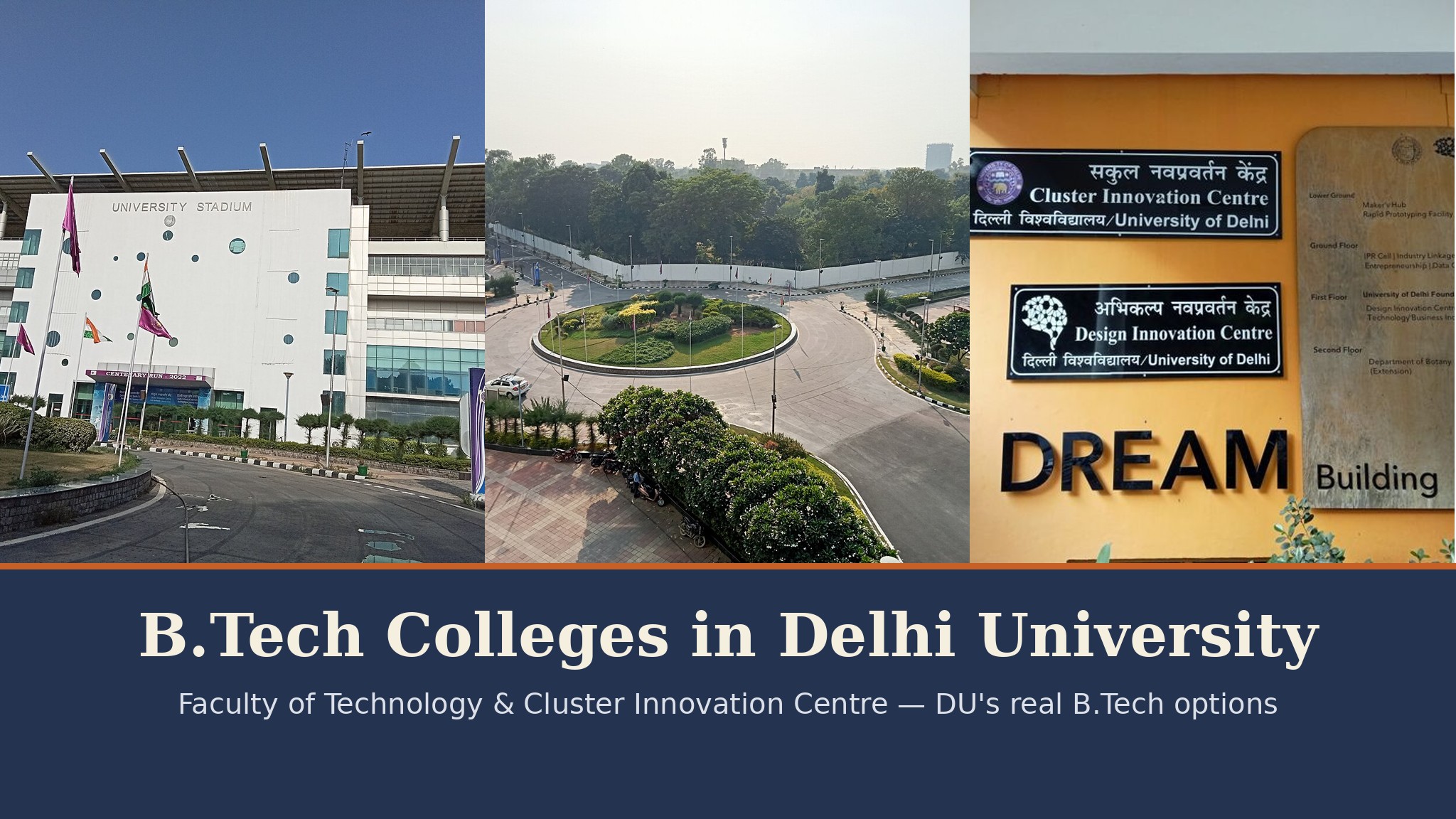
At a glance
Start with the fact most listicles get wrong: the University of Delhi itself offers B.Tech degrees in only two places — its Faculty of Technology (B.Tech in CSE, ECE and EE, admitted through JEE Main) and its Cluster Innovation Centre (B.Tech in Information Technology and Mathematical Innovations, admitted through CUET-UG and CSAS). Delhi College of Engineering is now Delhi Technological University, a separate university since 2009; Netaji Subhas Institute of Technology is now Netaji Subhas University of Technology, its own university since 2018; colleges such as Maharaja Agrasen Institute of Technology belong to Guru Gobind Singh Indraprastha University, not DU; and the B.Sc. (Hons) Computer Science degrees offered by DU's colleges are not B.Tech degrees. Because the genuine set is two institutions, this guide is structured around their programmes, admission routes, campus, costs and track records rather than an invented list of colleges. Entries are presented by topic, not ranked; seat and eligibility figures reported by education portals are marked as reported, and the university's Bulletin of Information is the governing document.
- Faculty of Technology, University of Delhi — Best for a conventional B.Tech (CSE, ECE or EE) carrying the University of Delhi name
- B.Tech in Computer Science and Engineering — Faculty of Technology — Best for a mainstream CSE degree inside a central university
- B.Tech in Electronics and Communication Engineering — Faculty of Technology — Best for electronics and communication within DU's own faculty
- B.Tech in Electrical Engineering — Faculty of Technology — Best for core electrical engineering at the University of Delhi
Shortlist and comparison
| Topic | Best for | What to verify |
|---|---|---|
| Faculty of Technology, University of Delhi | Best for a conventional B.Tech (CSE, ECE or EE) carrying the University of Delhi name | Programmes began in 2023 — there is no placement record yet; read the current Bulletin of Information |
| B.Tech in Computer Science and Engineering — Faculty of Technology | Best for a mainstream CSE degree inside a central university | Admission is by JEE Main rank only; reported intake is 120 seats — confirm in the seat matrix |
| B.Tech in Electronics and Communication Engineering — Faculty of Technology | Best for electronics and communication within DU's own faculty | Same JEE Main route and reported 120-seat intake; confirm eligibility in the Bulletin of Information |
| B.Tech in Electrical Engineering — Faculty of Technology | Best for core electrical engineering at the University of Delhi | The university's only electrical B.Tech; first batch has not graduated |
| Cluster Innovation Centre, University of Delhi | Best for an innovation-led, interdisciplinary route into a DU B.Tech | A small centre in the University Stadium building — visit the North Campus before deciding |
| B.Tech (Information Technology and Mathematical Innovations) — CIC | Best for computing blended with mathematics and project work | Reported 50 seats plus supernumerary; admission via CUET-UG and CSAS, not JEE Main |
| Admissions to the Faculty of Technology: JEE Main only | Best for understanding the FoT route before you apply | Registration-cum-allocation fee ₹1,500 (₹1,200 for SC/ST/PwBD), non-refundable — check the portal |
| Admissions to CIC: CUET-UG and CSAS | Best for understanding the CIC route before you apply | Confirm the current CUET subject combination in the CSAS documents for your year |
| Campus life on the North Campus: the University Stadium and sports complex | Best for judging the setting both institutions share | Teaching is woven into a general university campus, not a standalone engineering institute |
| Learning across the university: CIC's cluster model | Best for students who want interdisciplinary freedom | You draw courses and project resources across DU — not a fixed single-department syllabus |
| Design Innovation Centre and incubation at CIC | Best for students interested in start-ups and prototyping | Ask what access undergraduate teams get to the incubator and laboratories |
| Fees and costs: the official figure, and what you must verify | Best for avoiding wrong fee figures from aggregator sites | Portal fee totals conflict — trust only the Bulletin of Information and official fee notices |
| Outcomes, read honestly: no placement record yet at the Faculty of Technology | Best for cutting through misleading 'DU B.Tech placement' claims | Quoted DU placement figures usually describe DTU or NSUT, which are separate universities |
The brands in detail
Faculty of Technology, University of Delhi

The Faculty of Technology is the University of Delhi's own engineering faculty, based on the North Campus, and it is where the university's full-time B.Tech degrees actually live. It introduced B.Tech programmes in 2023 in three branches — Computer Science and Engineering, Electronics and Communication Engineering, and Electrical Engineering. Admission is not through any Delhi University entrance test: the university's official engineering admission portal states that admission to all three B.Tech programmes is made solely on the All India Common Rank List of JEE Main. Education portals report an intake of 120 seats in each branch, and the authoritative seat matrix and eligibility rules are published in the B.Tech Bulletin of Information on the university's admission website. Because the programmes began in 2023, the faculty is new: its first B.Tech cohort is still studying. The faculty also provides the academic home for doctoral programmes in technology areas, including the Cluster Innovation Centre's PhD programmes.
B.Tech in Computer Science and Engineering — Faculty of Technology
The B.Tech in Computer Science and Engineering at the Faculty of Technology is the university's flagship conventional engineering degree, launched with the faculty's first B.Tech intake in 2023. Education portals report 120 seats for the branch, with the official seat matrix published in the B.Tech Bulletin of Information. Admission is through the All India Common Rank List of JEE Main only, via the university's engineering admission portal — CUET scores are not used for this programme. Portals report eligibility of around 60 per cent in Physics, Chemistry and Mathematics at Class 12 level, but applicants must confirm the exact rule in the current Bulletin of Information, which governs each admission cycle. As a degree of the University of Delhi taught by a new faculty, it offers the DU name and a North Campus setting rather than a long placement history: the first cohort, admitted in 2023, has not yet graduated, so no placement record exists for it.
B.Tech in Electronics and Communication Engineering — Faculty of Technology
The B.Tech in Electronics and Communication Engineering is one of the three branches with which the Faculty of Technology opened its B.Tech admissions in 2023. Education portals report an intake of 120 seats, subject to the official seat matrix in the B.Tech Bulletin of Information. Like the faculty's other branches, admission is based solely on the All India Common Rank List of JEE Main, applied for through the university's engineering admission portal. Portals report Class 12 eligibility centred on Physics, Chemistry and Mathematics with a minimum aggregate of around 60 per cent; the Bulletin of Information for the admission year is the document to trust. Students choosing this branch should weigh the same trade-off as the faculty's other programmes: a University of Delhi degree and a new, growing faculty, set against the absence of any graduating batch or placement statistics so far. Visiting the North Campus and reading the current curriculum notice before applying is worthwhile.
B.Tech in Electrical Engineering — Faculty of Technology
The B.Tech in Electrical Engineering completes the Faculty of Technology's founding trio of branches, introduced in 2023 alongside Computer Science and Electronics and Communication. Education portals report 120 seats for the branch; the official seat matrix appears in the B.Tech Bulletin of Information on the university's admission website. Admission follows the same single route as the faculty's other B.Tech programmes: the All India Common Rank List of JEE Main, through the engineering admission portal — there is no separate university test and no CUET route for these seats. Reported eligibility asks for Physics, Chemistry and Mathematics at Class 12 with an aggregate of around 60 per cent, to be confirmed against the current bulletin. For students who specifically want core electrical engineering inside a central university, this is the University of Delhi's only such B.Tech. Judge it on curriculum and faculty, not on outcome statistics: the first batch has not graduated yet.
Cluster Innovation Centre, University of Delhi
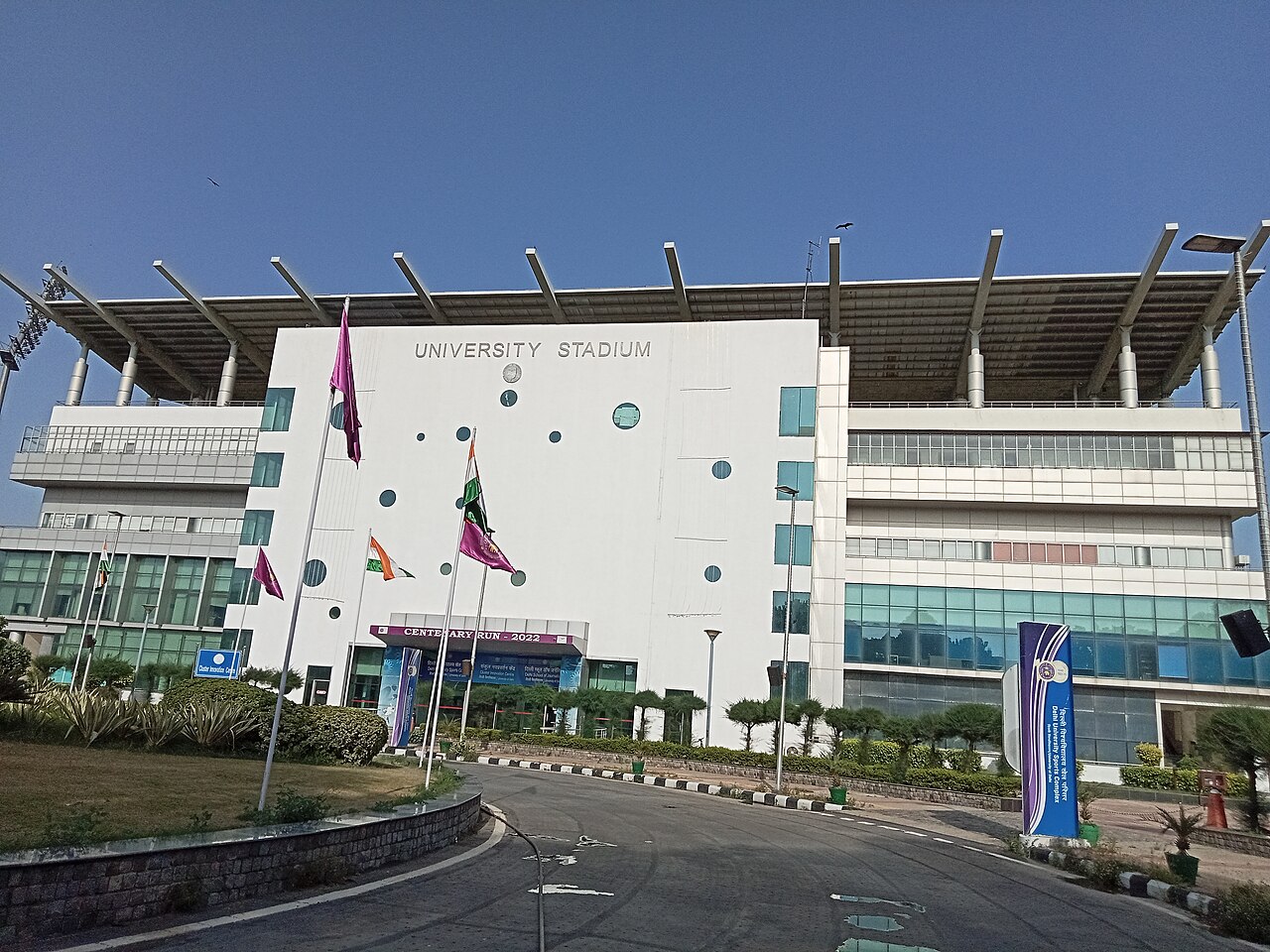
The Cluster Innovation Centre (CIC) is a Government of India-funded centre of the University of Delhi, founded in 2011 by the then Vice-Chancellor, Professor Dinesh Singh, and led by its director, Professor Shobha Bagai. It was set up as the prototype for the university innovation centres proposed by the National Innovation Council, and it introduced innovation as a credit-based course in India. Its motto is 'Evolving Senses, Dissolving Boundaries'. CIC is housed in the University Stadium building on the North Campus — its official address is Rugby Sevens Stadium, University Stadium Complex, North Campus, University of Delhi, Delhi – 110007. It runs undergraduate, postgraduate and doctoral programmes, but only one of them is a B.Tech. CIC also administers the Design Innovation Centre in the DREAM Building. For engineering applicants, CIC matters because it offers the University of Delhi's second, and very different, route into a B.Tech degree.
B.Tech (Information Technology and Mathematical Innovations) — Cluster Innovation Centre
The B.Tech in Information Technology and Mathematical Innovations is CIC's four-year undergraduate engineering degree, and it is deliberately unlike a conventional branch B.Tech. It blends information technology with mathematics and builds the degree around interdisciplinary, project-oriented learning, with students working on real-world problems in teams. Education portals report 50 seats, with additional supernumerary seats under university rules, and admission through CUET-UG followed by the university's CSAS allocation — not through JEE Main. Reported eligibility is around 60 per cent aggregate in the best four subjects including Mathematics, to be confirmed in the current admission documents. CIC's programme information also describes scope for minor specialisation in areas such as electronics, management and computational biology. It suits students who want computing combined with mathematics and innovation projects inside a small cohort. It does not suit students set on a traditional CSE syllabus or a large-campus engineering experience.
Admissions to the Faculty of Technology: JEE Main only
Admission to the Faculty of Technology's three B.Tech programmes works differently from most University of Delhi admissions, and the official engineering admission portal is explicit about it: for 2026-27, admission to B.Tech (CSE), B.Tech (ECE) and B.Tech (EE) will be done on the basis of the All India Common Rank List of Joint Entrance Examination (Main) – 2026 only. There is no CUET route and no separate university entrance examination for these seats. Applicants register on the university's engineering admission system and pay a registration-cum-allocation fee of ₹1,500 for UR, OBC-NCL and EWS candidates and ₹1,200 for SC, ST and PwBD candidates, which the portal states is non-refundable. The seat matrix, category-wise distribution and detailed eligibility conditions are given in the B.Tech Bulletin of Information published on the university's admission website. Because cut-offs move with each JEE Main cycle, applicants should rely on the bulletin and the portal's own allocation rounds rather than prediction articles.
Admissions to CIC: CUET-UG and CSAS
Admission to CIC's B.Tech runs through the standard University of Delhi undergraduate route: the Common University Entrance Test (CUET-UG), followed by allocation through the university's Common Seat Allocation System (CSAS) on the UG admission portal. Education portals report the required CUET subject combination for the B.Tech (IT and Mathematical Innovations) as one language from List A, plus Mathematics, plus Section III (General Test); applicants must confirm the combination for their admission year in the CSAS documents, because combinations and eligibility conditions are republished each cycle. Before 2022, CIC admitted students through the Delhi University Entrance Test (DUET); that route no longer applies. The practical sequence is: sit CUET-UG with the right subjects, register on CSAS when the university opens it, and list the CIC programme among your preferences. Keep the programme's small intake in mind — reported at 50 seats plus supernumerary seats — when judging how competitive allocation will be.
Campus life on the North Campus: the University Stadium and sports complex
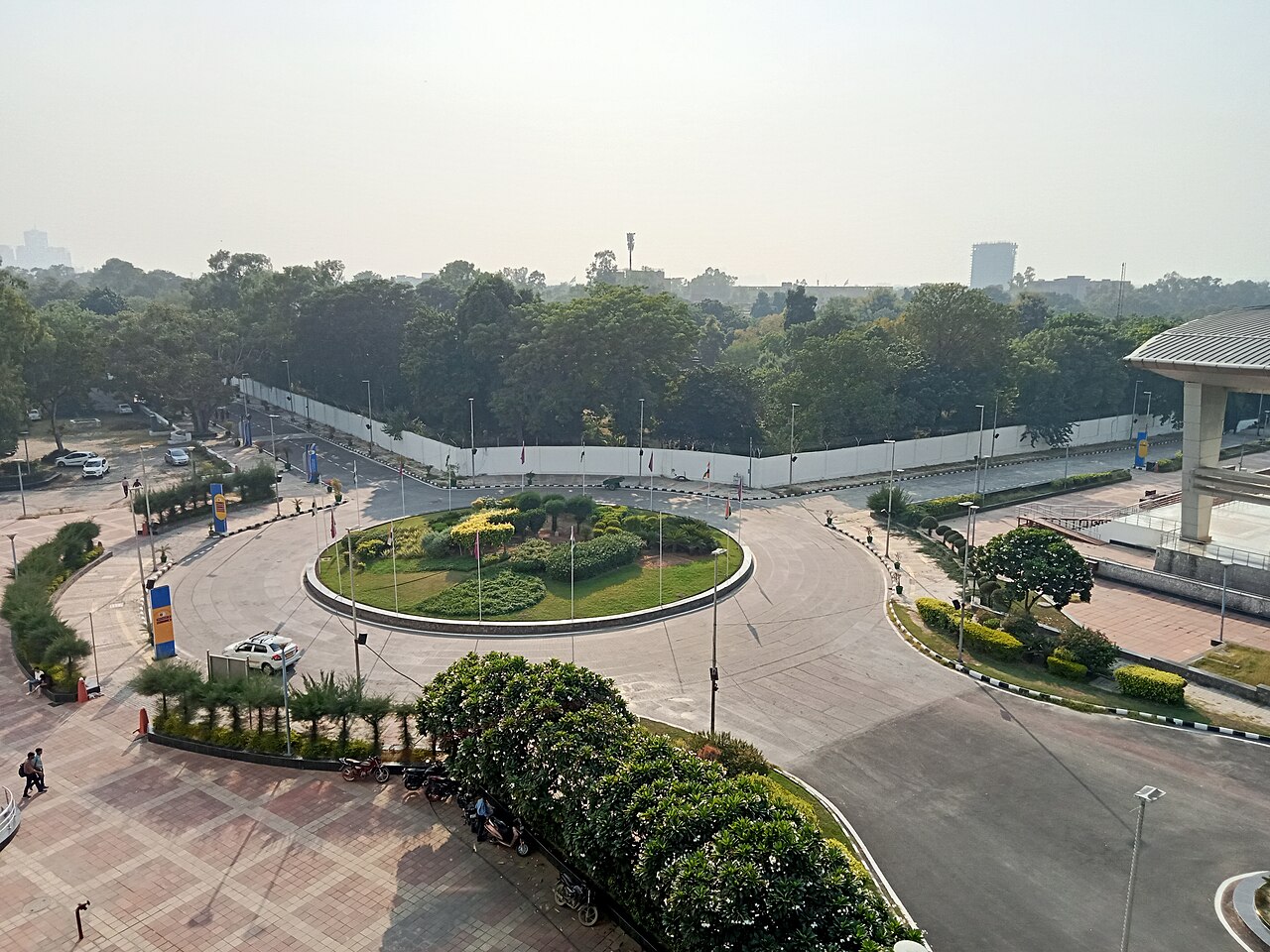
CIC's home is the University Stadium building — the Rugby Sevens Stadium — inside the University Stadium Complex on the University of Delhi's North Campus, at Delhi – 110007. The complex sits beside the Viceregal Lodge estate, handed to the university in 1933 and now the Vice-Chancellor's office, and next to the Faculty of Science, so CIC students study in the middle of the university's oldest campus rather than in a standalone institute. The nearest Delhi Metro station is Vishwavidyalaya on the Yellow Line. The Faculty of Technology's B.Tech teaching is also based on the North Campus. The setting is a genuine part of the offer for both institutions: students have the run of a large central university's libraries, societies, sports complex and events. Applicants used to the idea of a self-contained engineering campus should visit first — teaching, labs and student life here are woven into a general university, which is precisely the character of both programmes.
Learning across the university: CIC's cluster model
The 'cluster' in CIC's name describes its teaching model: instead of one closed department, students build projects and draw on courses, laboratories and faculty across the University of Delhi's colleges and departments — the meta-college or cluster idea the centre was created to prototype. Innovation is treated as credit-bearing coursework, and project work is aimed at real problems rather than only examinations. The model extends beyond the B.Tech: CIC also runs a B.A. (Honours) in Humanities and Social Sciences under a 'design your own degree' concept, and an M.Sc. in Mathematics Education offered jointly with Jamia Millia Islamia. For a B.Tech applicant, the honest reading is that CIC offers unusual academic freedom and interdisciplinary range inside a famous university, in a very small cohort. Students who want a fixed, branch-standard syllabus with large peer groups in their own discipline will find the Faculty of Technology's conventional degrees a better match.
Design Innovation Centre and incubation at CIC
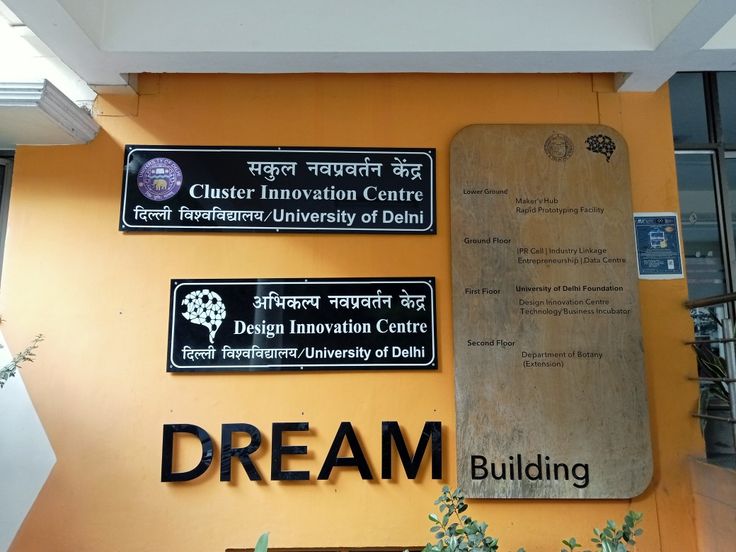
CIC administers a Design Innovation Centre (DIC), housed in the DREAM Building on the North Campus, as part of the national network of design innovation centres proposed by the National Innovation Council on a hub-and-spoke model. The DIC framework includes a Technology Business Incubator that offers laboratory access, workshops and mentorship to start-ups. The university has publicly invited start-up innovators to take up incubation at CIC; a 2023 call offered co-working and mentoring support, while stating that no stipend or grant was attached. For B.Tech students, this ecosystem is the centre's strongest practical asset: project work can connect to prototyping facilities, industry linkage activity and incubation support within the same institution. Applicants interested in start-ups should read the current DIC and incubator notices on CIC's website, and ask during admission interactions what access undergraduate project teams actually get to the incubator and its laboratories.
Fees and costs: the official figure, and what you must verify
Handle every fee figure for Delhi University B.Tech programmes with care. The only fee published on the university's official engineering admission portal at the time of research is the Faculty of Technology's registration-cum-allocation fee: ₹1,500 for UR, OBC-NCL and EWS applicants and ₹1,200 for SC, ST and PwBD applicants, stated as non-refundable. Programme fee totals quoted by education portals conflict sharply — for the Faculty of Technology, one major portal totals roughly ₹9.88 lakh over four years while another reports roughly ₹4.32 lakh in tuition — so neither should be used for planning. CIC's annual fee is widely reported by portals at about ₹11,000, which is plausible for a subsidised university centre but must still be confirmed against CIC's website and the current admission documents. The governing sources are the B.Tech Bulletin of Information, the CSAS fee notices and the institutions' own published fee structures for the admission year in question.
Outcomes, read honestly: no placement record yet at the Faculty of Technology
Outcome claims are where Delhi University B.Tech searches most often mislead. The Faculty of Technology's first B.Tech batch, admitted in 2023, has not graduated, so the faculty has no placement record, no alumni network in industry and no verified average package — any article quoting placement statistics for 'DU B.Tech' is almost always describing Delhi Technological University or Netaji Subhas University of Technology, which are separate universities. CIC is older, founded in 2011, and its students have a longer visible record of projects, research-flavoured work and incubation through the Design Innovation Centre, but its B.Tech is a small interdisciplinary programme rather than a mass placement pipeline, and it should not be judged by engineering-college placement tables either. The sensible basis for a decision is: for the Faculty of Technology, the University of Delhi's name, the curriculum and the faculty being built; for CIC, the project-based model and innovation ecosystem. Verify anything else directly with the institutions.
How to choose
Start with the real decision: who will use this, where, how often, and what would make the choice unsafe or disappointing? The following checks keep the shortlist practical.
- Confirm the institution is genuinely part of the University of Delhi — DTU, NSUT and GGSIPU colleges are not
- Match the admission route: JEE Main for the Faculty of Technology, CUET-UG plus CSAS for the Cluster Innovation Centre
- Take seats, eligibility and fees only from the current Bulletin of Information, not aggregator summaries
- Weigh programme age: the Faculty of Technology's first B.Tech batch has not graduated yet
- Decide between a conventional branch degree at the Faculty of Technology and an interdisciplinary degree at CIC
What to verify before you commit
Confirm the current specification, price or availability, terms, and seller or provider identity. For companies and services, request a written scope, named contact, references, and cancellation or warranty terms. For products, compare the unit price, compatibility, return window, and genuine support.
Editorial update
Start with the fact most listicles get wrong: the University of Delhi itself offers B.Tech degrees in only two places — its Faculty of Technology (B.Tech in CSE, ECE and EE, admitted through JEE Main) and its Cluster Innovation Centre (B.Tech in Information Technology and Mathematical Innovations, admitted through CUET-UG and CSAS). Delhi College of Engineering is now Delhi Technological University, a separate university since 2009; Netaji Subhas Institute of Technology is now Netaji Subhas University of Technology, its own university since 2018; colleges such as Maharaja Agrasen Institute of Technology belong to Guru Gobind Singh Indraprastha University, not DU; and the B.Sc. (Hons) Computer Science degrees offered by DU's colleges are not B.Tech degrees. Because the genuine set is two institutions, this guide is structured around their programmes, admission routes, campus, costs and track records rather than an invented list of colleges. Entries are presented by topic, not ranked; seat and eligibility figures reported by education portals are marked as reported, and the university's Bulletin of Information is the governing document.
Frequently asked questions
How should I use this guide?
Use the shortlist to define what matters to you, then verify current price, availability, rules, credentials, or catalogue details at the source before you decide.
Is this a fixed ranking?
No. The refreshed page is an editorial starting point organised by fit and evidence. The right choice depends on your use case, location, budget, and timing.
When will this page be updated?
VisitBest reviews time-sensitive details when reliable public information changes. Send corrections or newer source links to visitbest10@gmail.com.
Keep exploring

Best Educational Websites in India: Top Official and Free Learning Sites for Students
A practical guide to the best educational websites for Indian students — the official government platforms for textbooks, board information and free…

Pharma Companies in Delhi (2026)
Explore pharma companies in Delhi — ratings, company types, comparison tables, and VisitBest directory listings.

Pharma Companies in Gurugram (2026)
Explore pharma companies in Gurugram — ratings, company types, comparison tables, and VisitBest directory listings.