
VisitBest guide
Cockatoo Birds: White Cockatoos, Black Cockatoos, Corellas and the Galah
A guide to 16 cockatoo species — sulphur-crested, white, salmon-crested, citron-crested, blue-eyed and Ducorps's cockatoos, the palm cockatoo, galah, Major…
In this guide
At a glance
Cockatoos are the crested branch of the parrot family, found wild only in Australia, New Guinea, Indonesia, the Philippines and the Pacific islands. This guide focuses on identification and responsible observation — what each species looks like, where it lives and how it feeds — using well-established natural-history references. The family's smallest member, the cockatiel, is often kept and classified slightly apart, so it is noted here rather than given a full entry.
- Sulphur-crested cockatoo — Australia's big, noisy white cockatoo with the yellow crest
- White cockatoo — All-white umbrella-crested cockatoo from the North Maluku islands
- Salmon-crested cockatoo — The largest white cockatoo, flushed salmon-pink
- Citron-crested cockatoo — Sumba's rare cockatoo with an orange crest
Shortlist and comparison
| Topic | Best for | What to verify |
|---|---|---|
| Sulphur-crested cockatoo | Australia's big, noisy white cockatoo with the yellow crest | Raised yellow crest, yellow underwing wash and pale blue eye-ring |
| White cockatoo | All-white umbrella-crested cockatoo from the North Maluku islands | Huge semicircular crest that fans open like an umbrella |
| Salmon-crested cockatoo | The largest white cockatoo, flushed salmon-pink | Deep salmon-pink crest feathers shown when the crest is raised |
| Citron-crested cockatoo | Sumba's rare cockatoo with an orange crest | Orange crest and yellow ear patch separate it from sulphur-crested |
| Blue-eyed cockatoo | White cockatoo with a vivid blue eye-ring from New Britain | Bright turquoise-blue bare skin rings the eye |
| Ducorps's cockatoo | Solomon Islands cockatoo with a sail-shaped crest | Broad triangular crest and blue eye-ring; smaller and tamer |
| Palm cockatoo | Huge black cockatoo with a bare red cheek patch | Massive bill, spiky crest and red cheek that flushes brighter |
| Galah | Pink-and-grey cockatoo of Australian open country | Rose-pink chest and face with a grey back — unmistakable |
| Major Mitchell's cockatoo | Soft pink inland cockatoo with a banded crest | Crest banded red, yellow and white when raised |
| Gang-gang cockatoo | Small slate-grey cockatoo; the male wears a scarlet head | Wispy filamentous crest and scalloped feather edges |
| Yellow-tailed black cockatoo | Black cockatoo with yellow cheek and tail panels | Yellow cheek patch and yellow panels in the tail |
| Red-tailed black cockatoo | Black cockatoo whose tail panels blaze red | Males show plain red tail panels; females are speckled |
| Carnaby's black cockatoo | Short-billed black cockatoo of south-western Australia | Large white cheek patch and a shorter, deeper bill |
| Little corella | Small playful white corella of huge outback flocks | Short bill, blue-grey eye-ring and a pink blush at the bill base |
| Long-billed corella | White corella with a long digging bill and red throat band | Elongated upper bill and red-orange marks on face and throat |
| Tanimbar corella | Goffin's cockatoo — the small white tool-user from Tanimbar | Pink lores between eye and bill; among the smallest white cockatoos |
The brands in detail
Sulphur-crested cockatoo
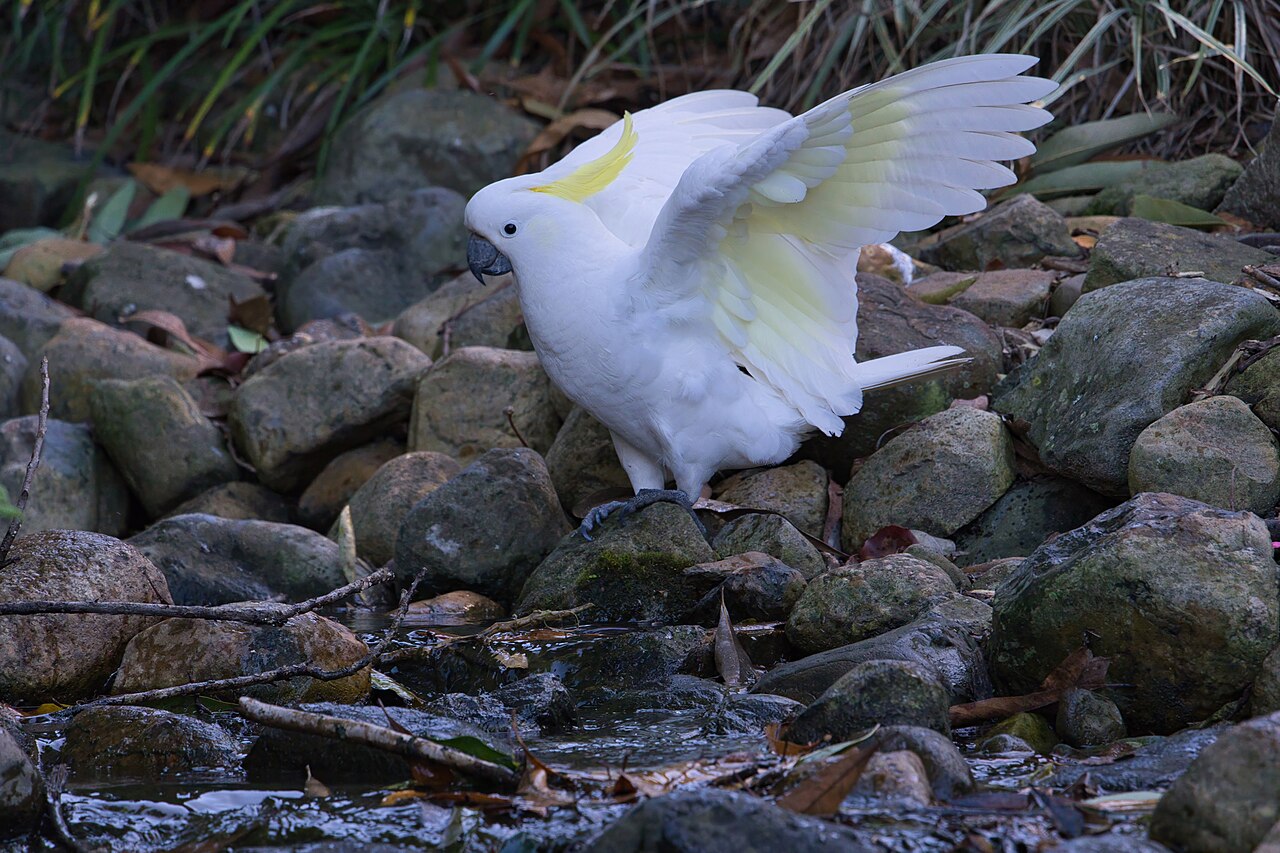
The sulphur-crested cockatoo (Cacatua galerita) is the big white cockatoo most people picture first: snow-white plumage, a forward-curving crest of bright yellow that it raises when excited or alarmed, yellow washes under the wings and tail, and a ring of pale blue skin around the eye. It is native to northern and eastern Australia and southern New Guinea, and lives in woodland, rainforest edges, farmland and city parks. Bold, intelligent and very long-lived, it feeds on seeds, berries, nuts, roots and insect larvae, often in noisy flocks that drop to the ground to graze and post lookouts in the trees. Its screech carries for kilometres, and its powerful bill can strip bark and splinter timber. The IUCN Red List classifies the species as Least Concern, and it remains common across much of its range.
White cockatoo
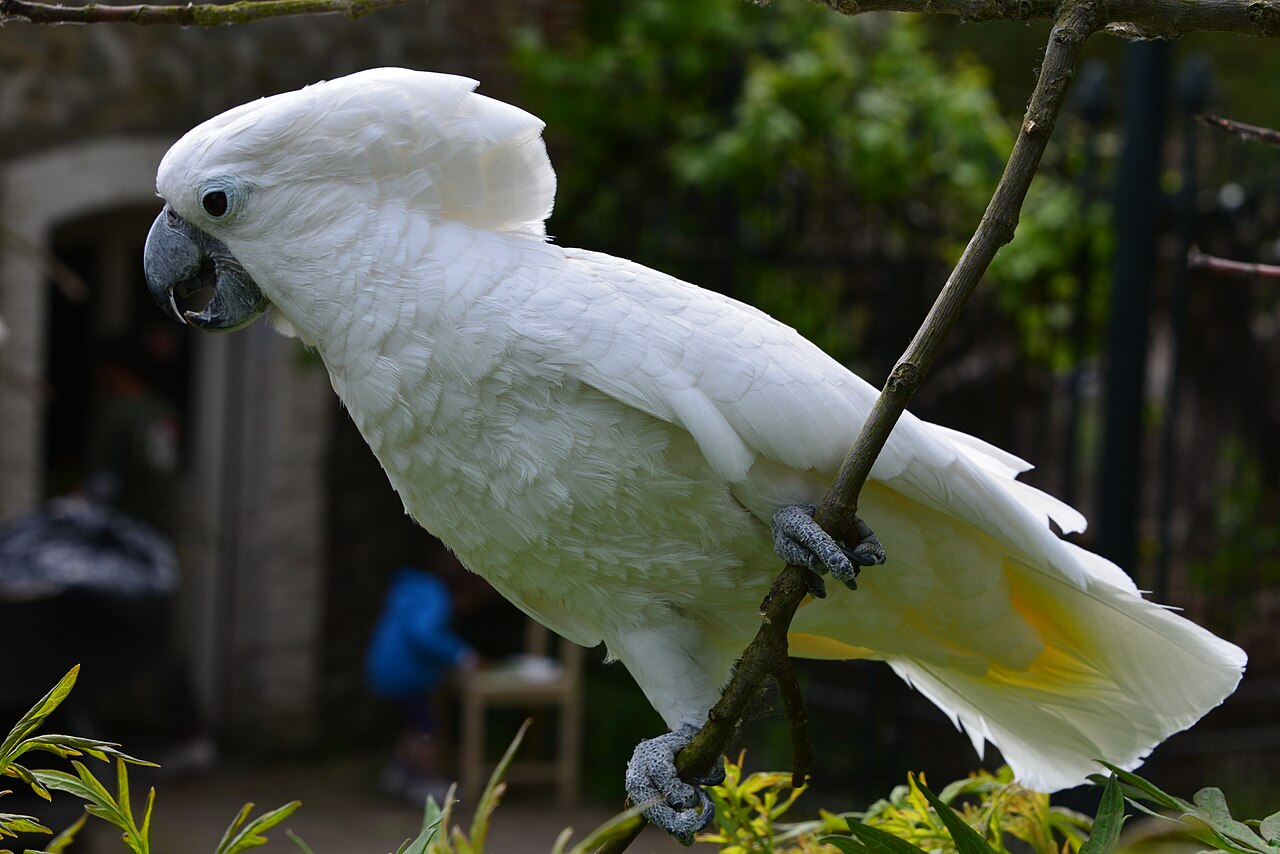
The white cockatoo (Cacatua alba), also called the umbrella cockatoo, is pure white from crest to tail, with yellow only on the underside of the wings. Its party trick is the crest: a broad, semicircular fan that springs upright around the head when the bird is excited, curious or alarmed, giving the species its umbrella name. Males have dark brown or black eyes, females warmer reddish-brown ones. It is found only on the North Maluku islands of Indonesia — Halmahera, Bacan, Ternate, Tidore, Kasiruta and Mandioli — in lowland forest and mangrove edges. It feeds on fruit, seeds, nuts, berries and insects, and is gentle and quiet by cockatoo standards in the wild. Heavy trapping for the cage-bird trade and logging have hit it hard, and the IUCN Red List classifies the white cockatoo as Endangered.
Salmon-crested cockatoo
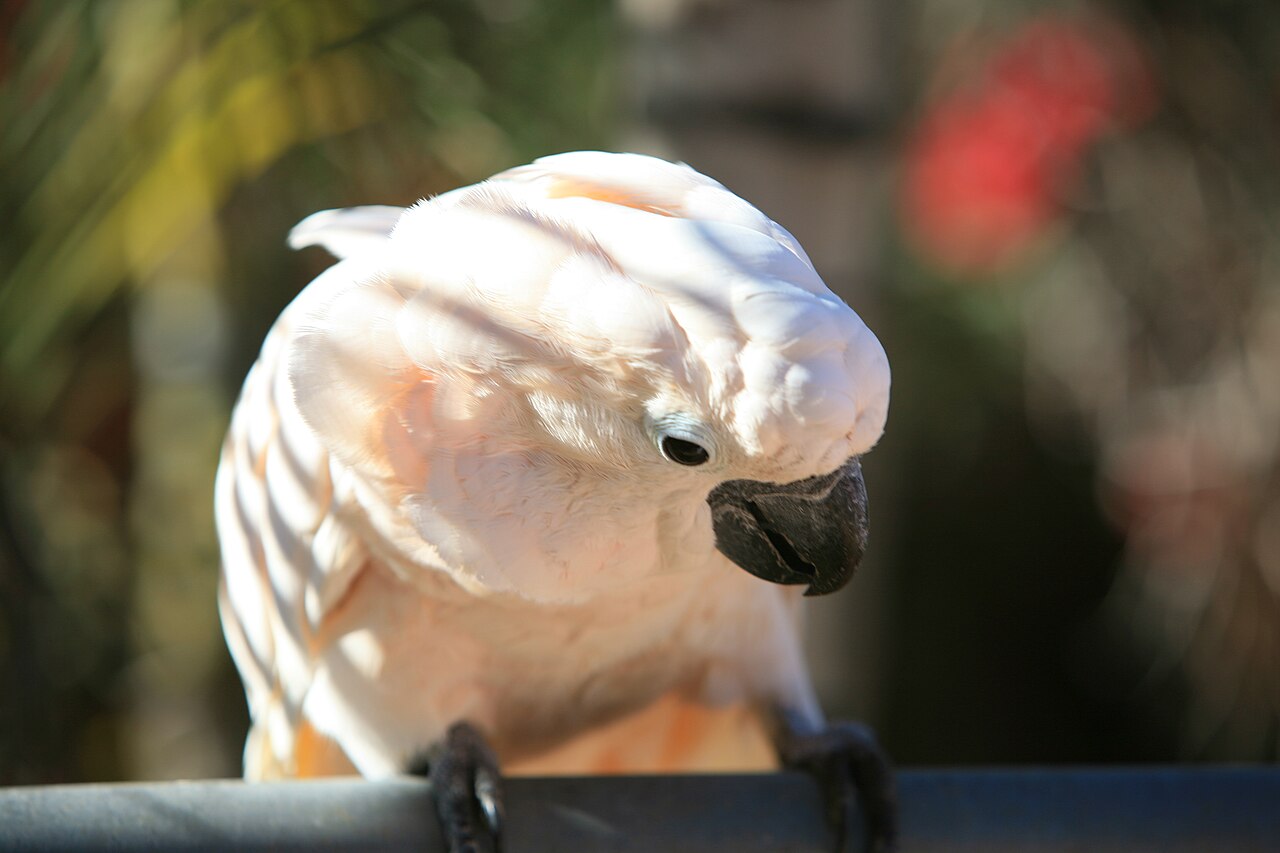
The salmon-crested cockatoo (Cacatua moluccensis), or Moluccan cockatoo, is the largest of the white cockatoos, and one of the most beautiful: white plumage washed with pink, and long crest feathers of deep salmon-pink that show fully when the crest is raised. It comes from a single island group — Seram and its neighbours in the South Maluku islands of Indonesia — where it lives in lowland rainforest, usually below 1,000 metres. It eats seeds, nuts, fruit, berries and insects, cracking hard shells in its massive bill, and travels in pairs or small, very noisy groups; its voice is among the loudest of any parrot. Decades of trapping for the pet trade, plus logging of its forest, have reduced numbers sharply. The IUCN Red List classifies the salmon-crested cockatoo as Endangered, and international trade in wild birds is banned.
Citron-crested cockatoo
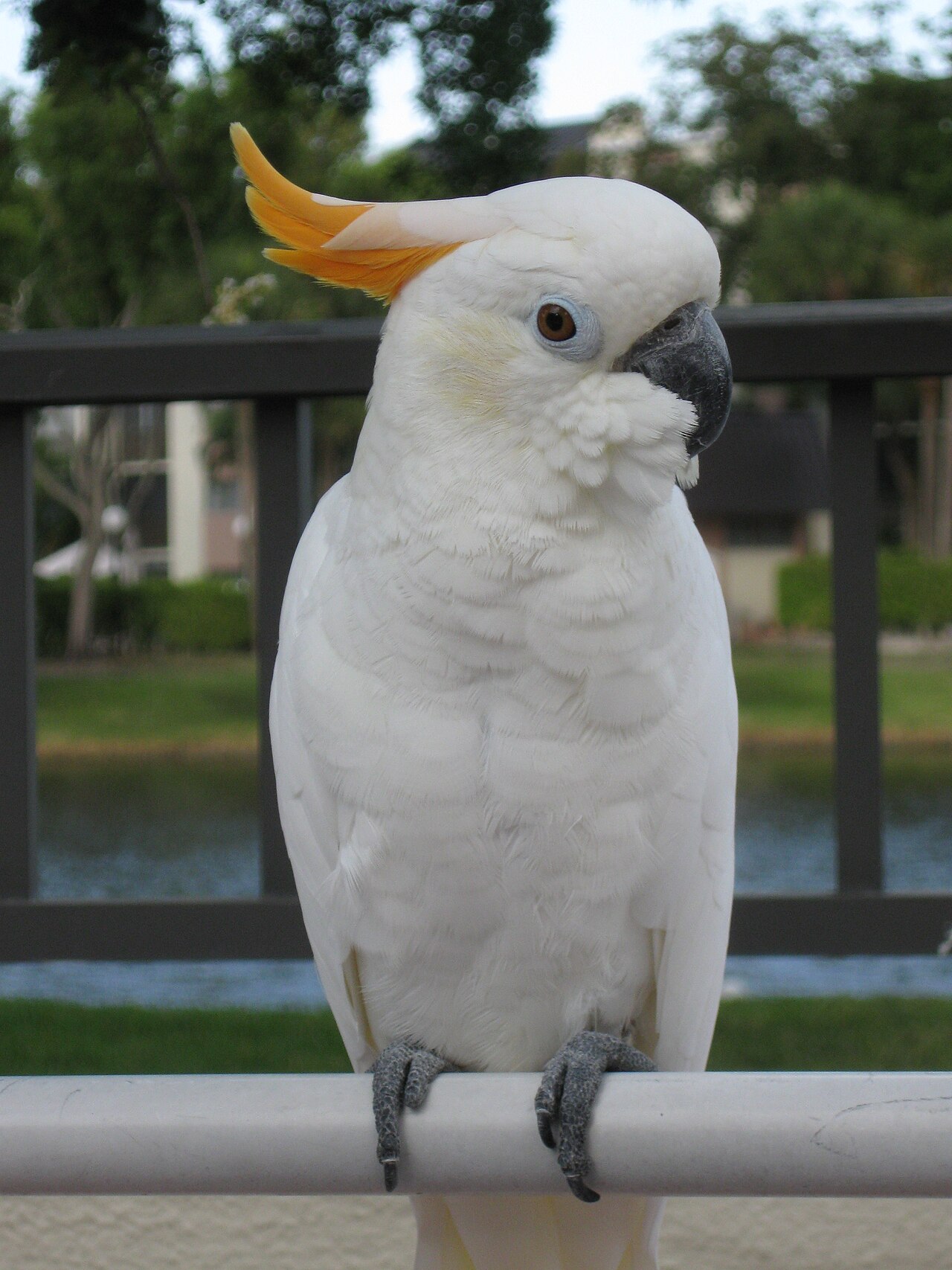
The citron-crested cockatoo (Cacatua citrinocristata) is the rarest bird in this guide. It looks like a smaller sulphur-crested cockatoo, but the crest is a rich orange rather than lemon-yellow, and the ear patch is washed yellow-orange. Long treated as a subspecies of the yellow-crested cockatoo, it is now recognised as a species in its own right. It lives only on Sumba, an Indonesian island east of Bali, in dry deciduous forest, woodland and scattered trees around farmland. It feeds on seeds, fruit, berries and flowers, moving in pairs or small parties and roosting communally. Relentless trapping for the cage-bird trade has emptied much of the island, and remaining birds are confined to fragments of forest. The IUCN Red List classifies the citron-crested cockatoo as Critically Endangered — the most threatened cockatoo in this guide.
Blue-eyed cockatoo
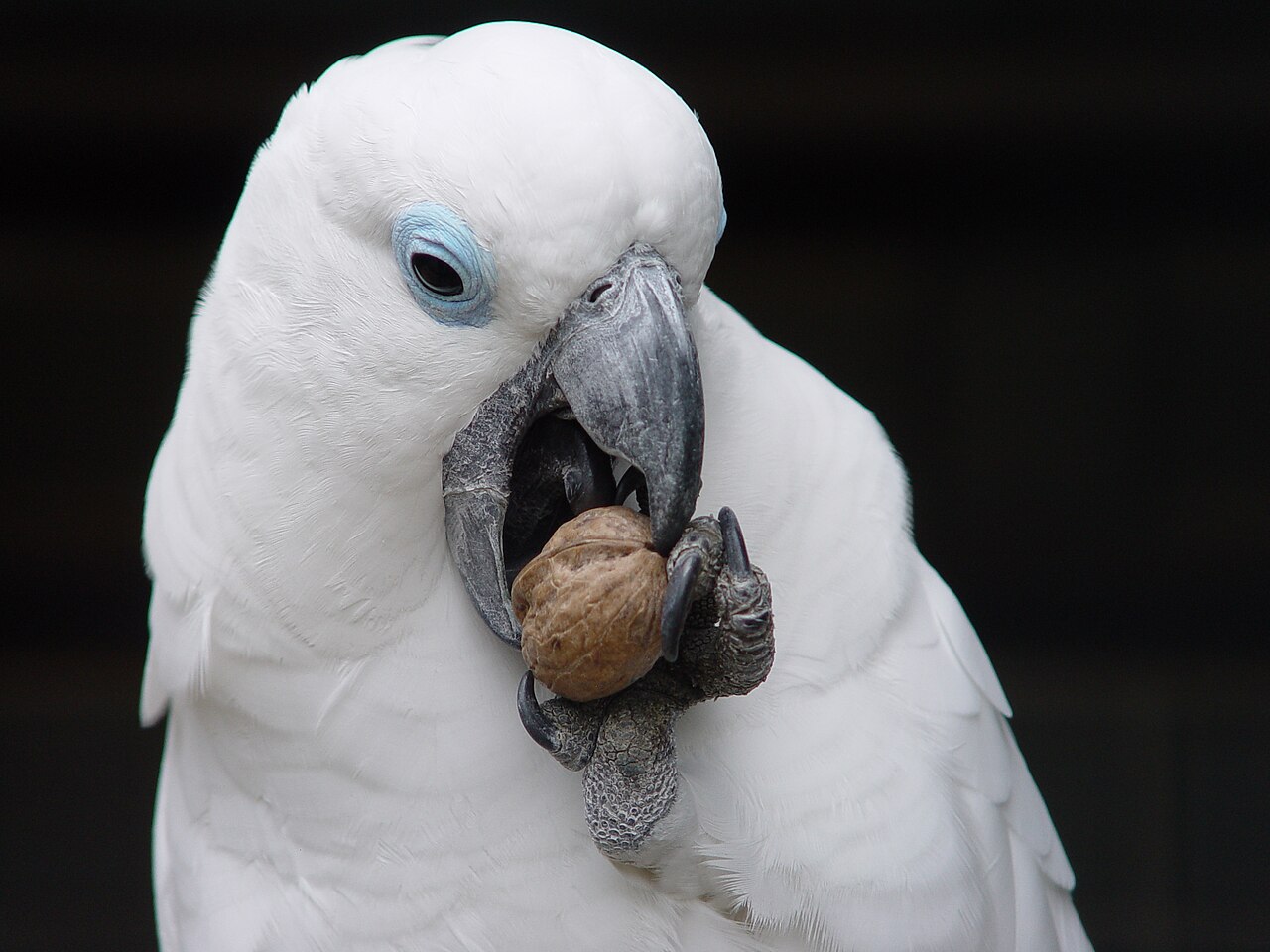
The blue-eyed cockatoo (Cacatua ophthalmica) is named for the vivid turquoise-blue ring of bare skin around its eye, the brightest of any cockatoo. Otherwise it is a typical Cacatua: white plumage with a lemon wash under the wings and tail, a rounded, recurved white crest and a big black bill. It is found only on New Britain and New Ireland in Papua New Guinea's Bismarck Archipelago, in lowland rainforest up into the hills. It feeds on seeds, nuts, fruit, berries and insects, and is reported to be shyer and quieter than its Australian cousins, travelling in pairs or small groups through the canopy. Logging of lowland forest for timber and oil-palm planting is its main threat, along with some trapping. The IUCN Red List classifies the blue-eyed cockatoo as Vulnerable.
Ducorps's cockatoo
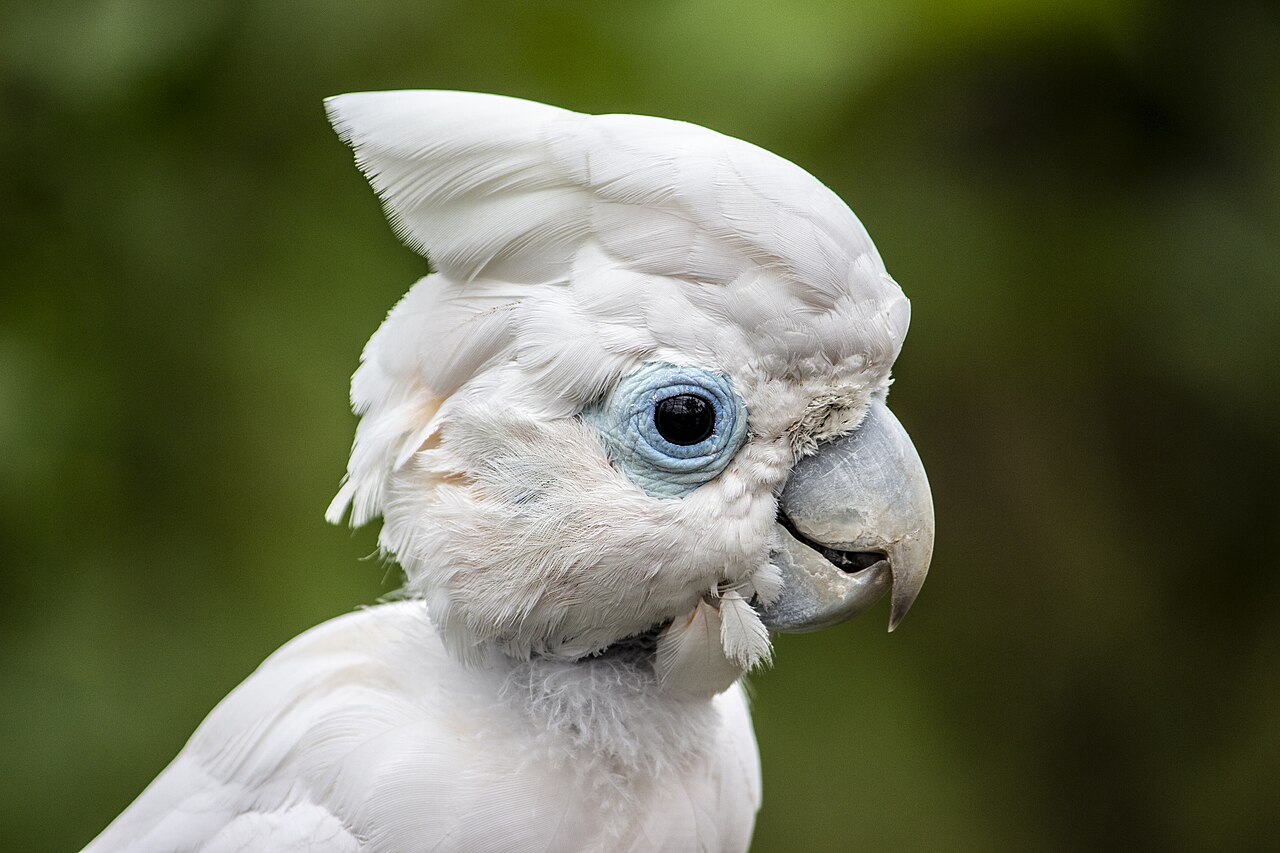
Ducorps's cockatoo (Cacatua ducorpsii), also called the Solomons cockatoo, is a smaller white cockatoo with a broad, triangular, sail-like crest and a bright blue eye-ring — the combination separates it from the blue-eyed cockatoo, whose crest is rounder and which lives further west. It is found across the Solomon Islands in the south-west Pacific, in lowland forest, second growth, gardens and coconut plantations. It feeds on seeds, fruit, berries, blossom and insects, and is a familiar, confiding bird around villages, often tame enough to watch at close range as it feeds. Unlike many island cockatoos it remains widespread and reasonably numerous, helped by its ability to use disturbed habitats. The IUCN Red List classifies Ducorps's cockatoo as Least Concern, though it is protected from commercial export by its CITES listing.
Palm cockatoo
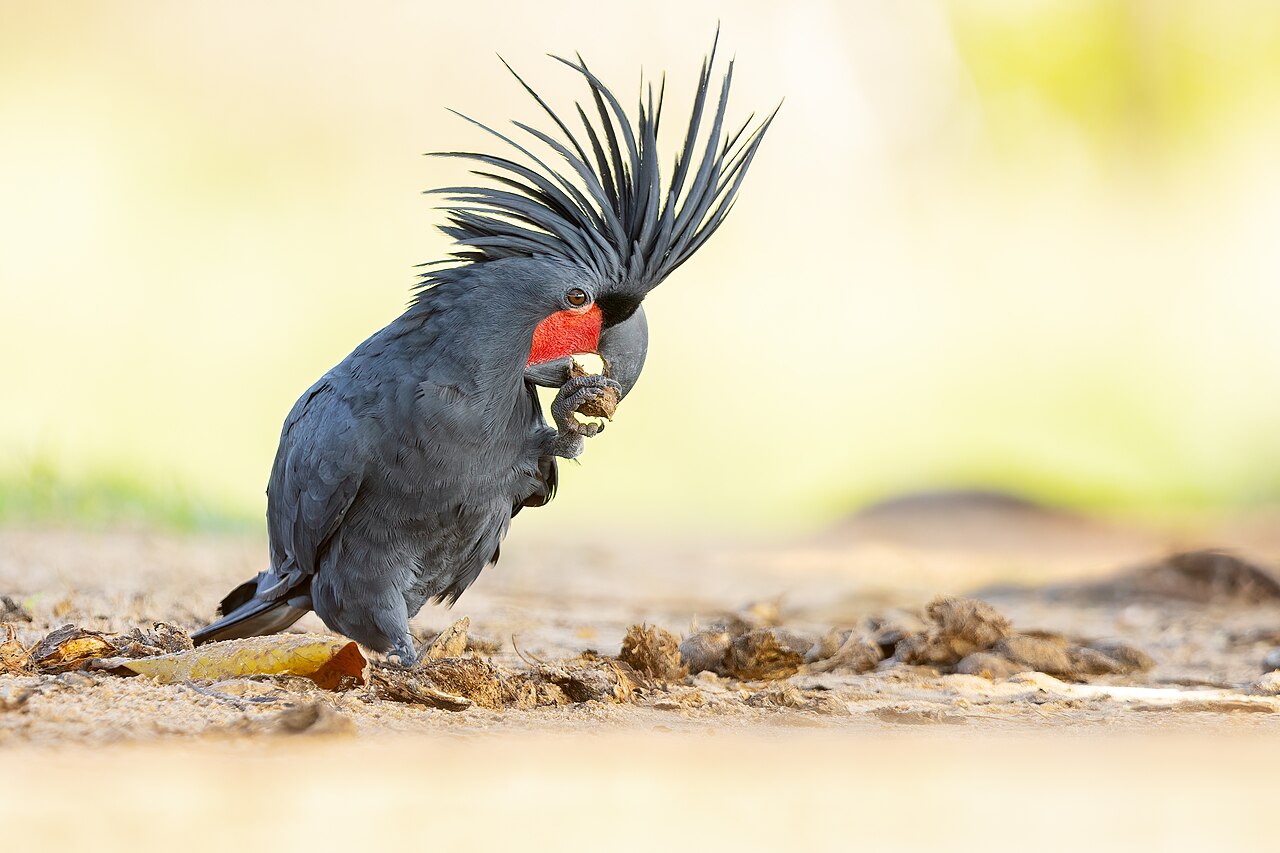
The palm cockatoo (Probosciger aterrimus) is one of the world's largest parrots and looks like no other: smoky black to dark grey plumage, a huge arched black bill, a tall crest of long, spiky feathers, and a bare red cheek patch that flushes deeper crimson when the bird is excited. It lives in the rainforests and savanna woodlands of New Guinea and Australia's Cape York Peninsula. It feeds on the hard seeds of pandanus and other palms and nuts that few other birds can crack. Males are famous for drumming: a bird snaps off a stick, trims it, and beats it against a hollow dead trunk to advertise the nest hollow to females — a rare case of a bird making and using a musical instrument. Slow breeding makes it vulnerable to habitat loss. The IUCN Red List classifies it as Near Threatened, with a declining population.
Galah
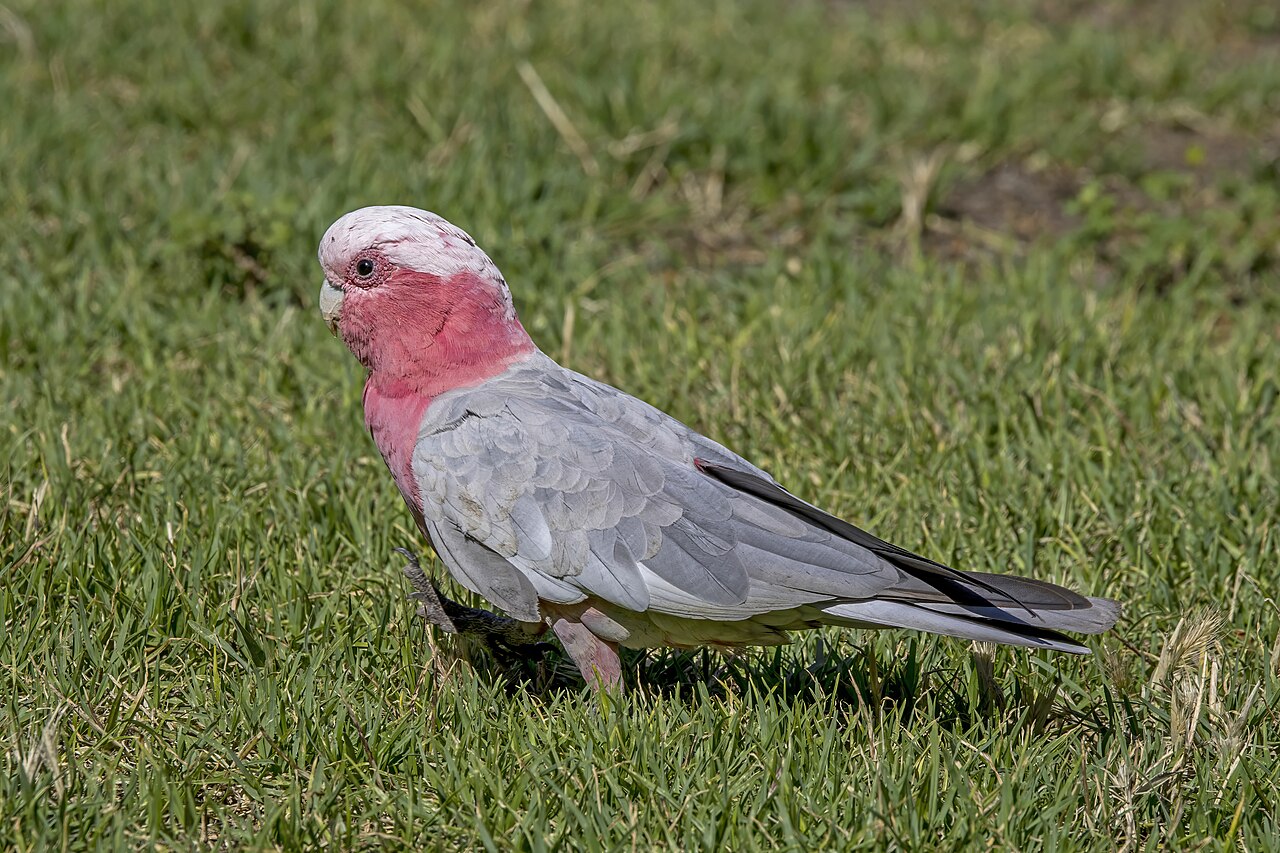
The galah (Eolophus roseicapilla) is Australia's pink-and-grey cockatoo, and one of the continent's most familiar birds: rose-pink face, neck and underparts, pale grey back and wings, and a short pinkish-white crest. It lives almost everywhere in mainland Australia except the wettest forests and the driest desert core, favouring open grassland, farmland, watercourses and towns. Galahs feed on the ground in flocks on seeds, grain, roots and bulbs, and are strong, acrobatic fliers whose flocks twist and wheel in unison, flashing pink and grey. They nest in tree hollows, lining them with eucalypt leaves. Land clearing and grain farming have suited it, and numbers have grown over the last century; in Australian slang, a 'galah' is a fool, after the bird's clownish antics. The IUCN Red List classifies the galah as Least Concern.
Major Mitchell's cockatoo
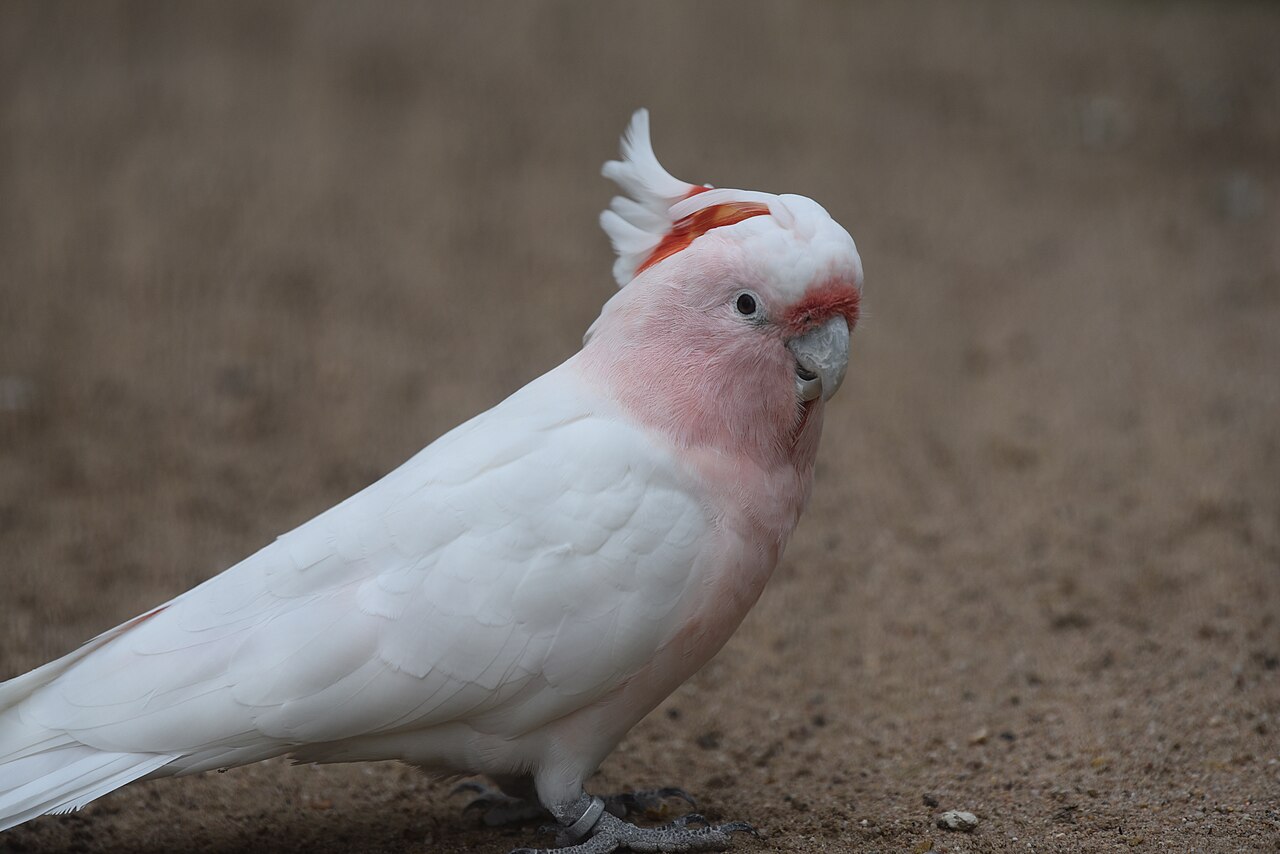
Major Mitchell's cockatoo (Lophochroa leadbeateri), now often called the pink cockatoo, is the inland counterpart of the galah: soft salmon-pink underparts and face, white wings and back, and a spectacular crest banded in scarlet, yellow and white that it raises in display. It is a bird of arid and semi-arid inland Australia — mallee, mulga and cypress-pine woodland, always within reach of water. It feeds on the ground and in trees on seeds, especially native grasses and melon fruits, plus roots, nuts and insect larvae. Quieter and less gregarious than other cockatoos, it travels in pairs or family parties and needs large old hollow-bearing trees to nest. Clearing of inland woodland has fragmented its habitat across the wheat belts. The IUCN Red List classifies Major Mitchell's cockatoo as Least Concern worldwide, though numbers are falling as inland woodland is cleared.
Gang-gang cockatoo
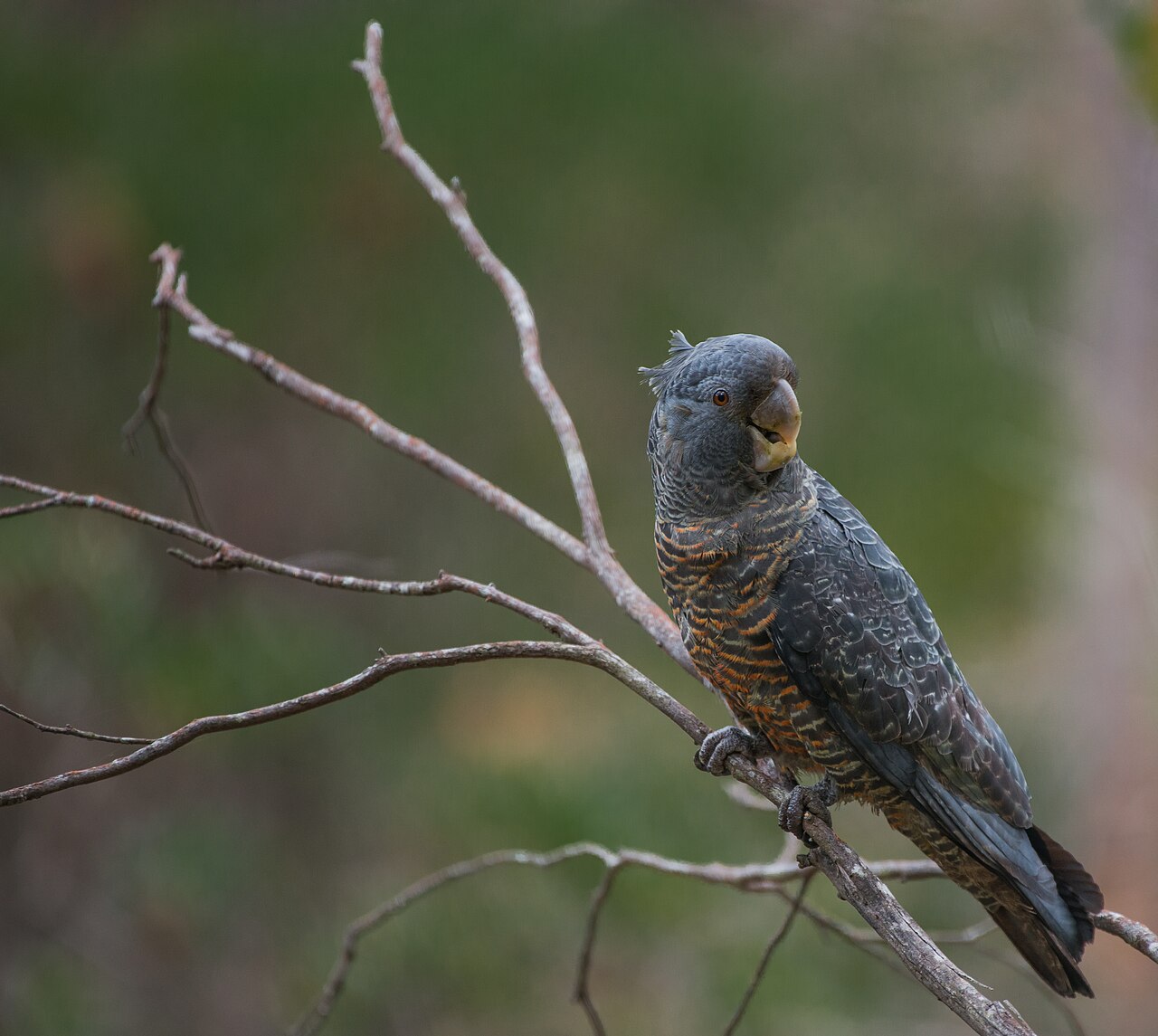
The gang-gang cockatoo (Callocephalon fimbriatum) is a small, stocky cockatoo of cool mountain forests, slate-grey overall with fine scalloped feather edges. The male is unmistakable, with a scarlet head and a wispy, filamentous crest like a tuft of wool; the female is plainer grey with orange barring underneath, as in the photograph here. It lives in the ranges of south-eastern Australia, moving to lower coastal country in winter. Gang-gangs feed quietly in the canopy on eucalypt seeds, acacia pods, pine cones and berries such as hawthorn, cracking them in a strong bill. Their call is a strange creaking croak, often compared to a rusty gate hinge or a cork drawn from a bottle. Catastrophic bushfires have burned much of its forest home in recent years. The IUCN Red List classifies the gang-gang cockatoo as Vulnerable.
Yellow-tailed black cockatoo
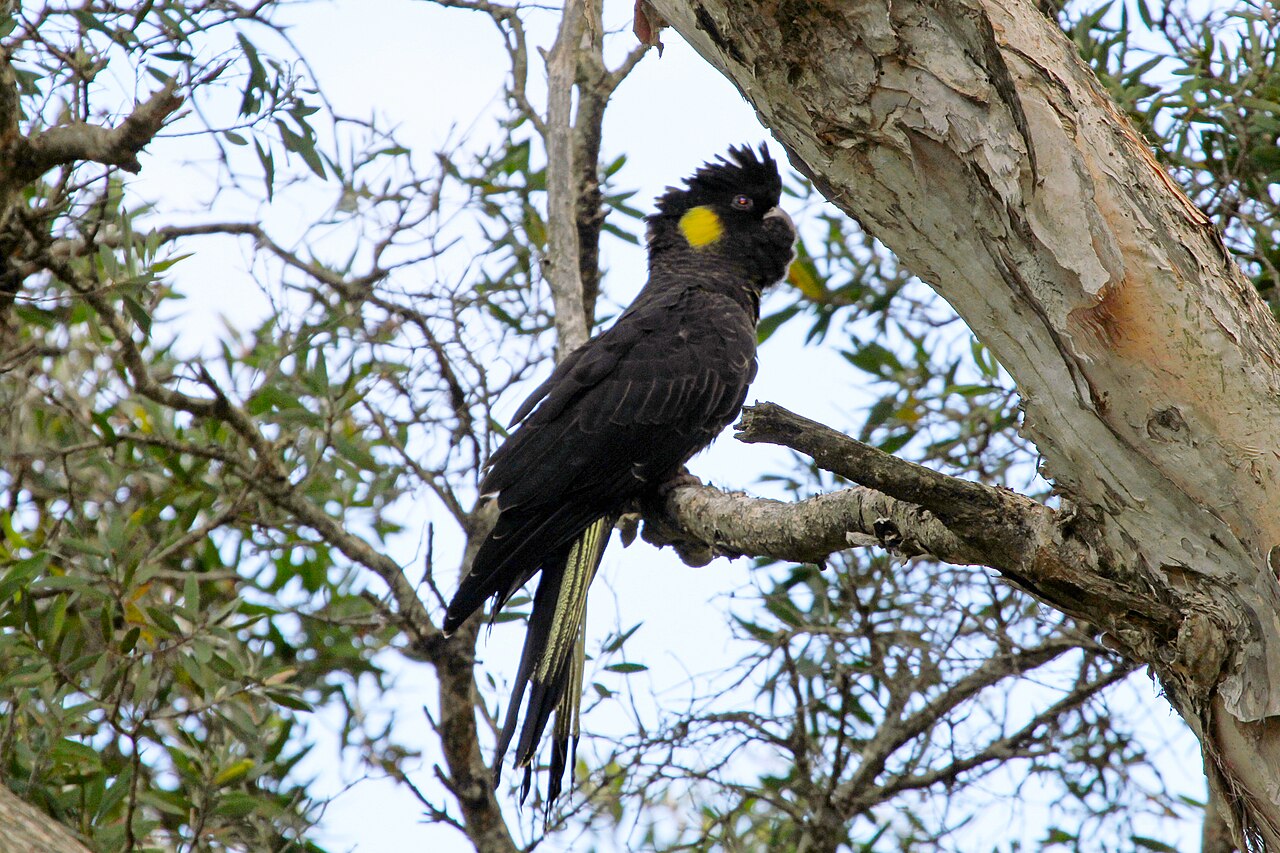
The yellow-tailed black cockatoo (Zanda funerea) is a big, slow-flying forest cockatoo of eastern Australia: brownish-black plumage, a bright yellow cheek patch, and broad yellow panels in the tail that show when the tail fans open. It lives in eucalypt forest and woodland from Queensland to Victoria and Tasmania, and in pine plantations. Its speciality is extracting fat wood-boring grubs: the bird tears strips of bark and shreds dead wood with its powerful bill to reach beetle larvae, and also feeds on banksia, hakea and pine seeds. Flight is languid, with deep, slow wingbeats, and its far-carrying wailing call is one of the classic sounds of the Australian bush. It needs very old, hollow eucalypts for nesting, so it depends on mature forest. The IUCN Red List classifies it as Least Concern.
Red-tailed black cockatoo
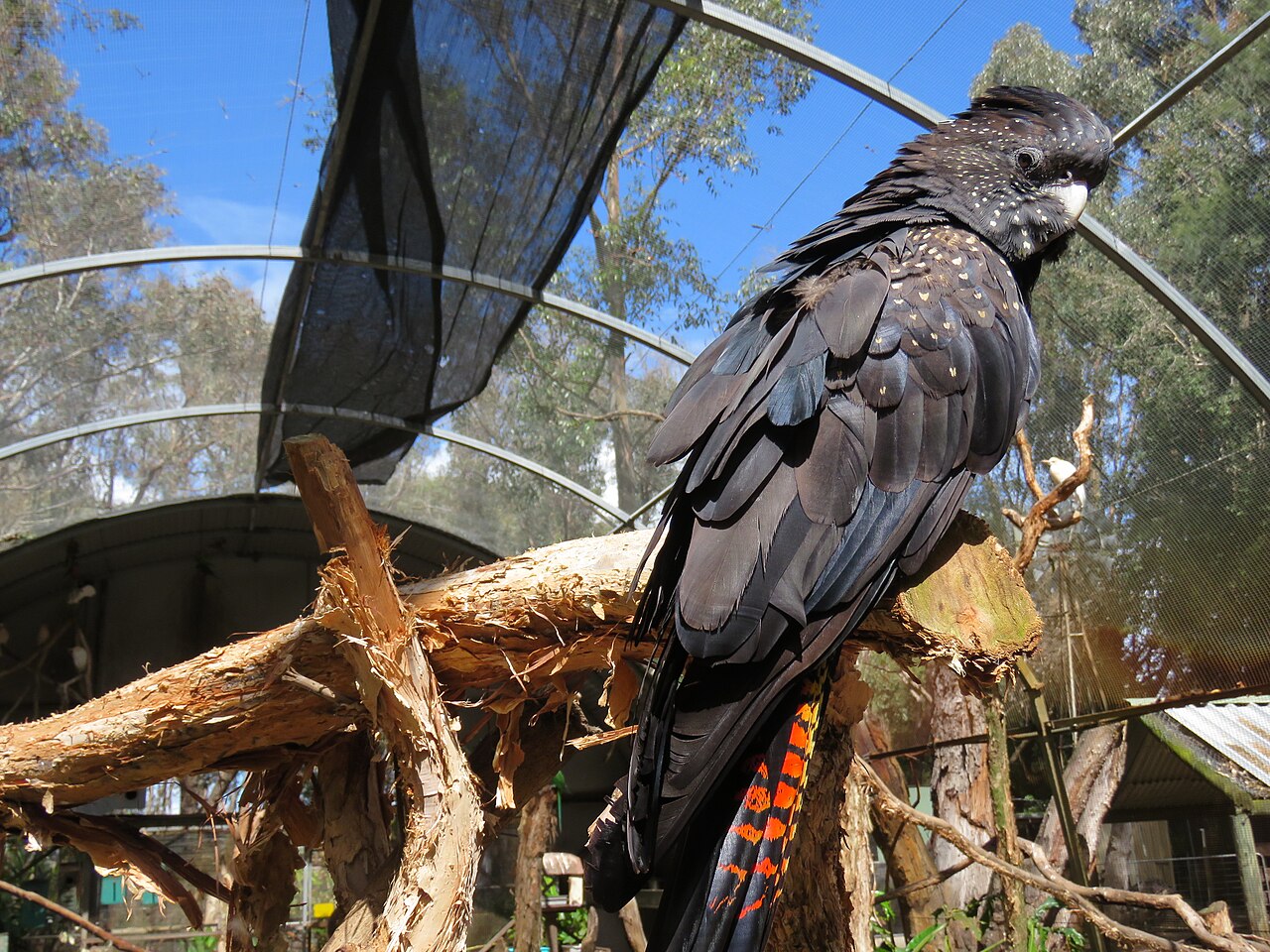
The red-tailed black cockatoo (Calyptorhynchus banksii) is named for the panels in its tail: in males they are a plain, blazing scarlet; in females — like the bird photographed here — the tail is barred red and orange and the head and wings are speckled with yellow. It is found across northern, eastern and parts of western Australia in five subspecies, in eucalypt woodland, river corridors and savanna. It feeds mainly on seeds, of eucalypts, marri, casuarinas and acacias, husking them in a heavy bill and dropping a litter of debris beneath feeding trees. Flocks are noisy but wary, and the birds commute between feeding trees and water each morning and evening. Some southern subspecies are locally threatened by the loss of their specialised food trees. The IUCN Red List classifies the species as a whole as Least Concern.
Carnaby's black cockatoo
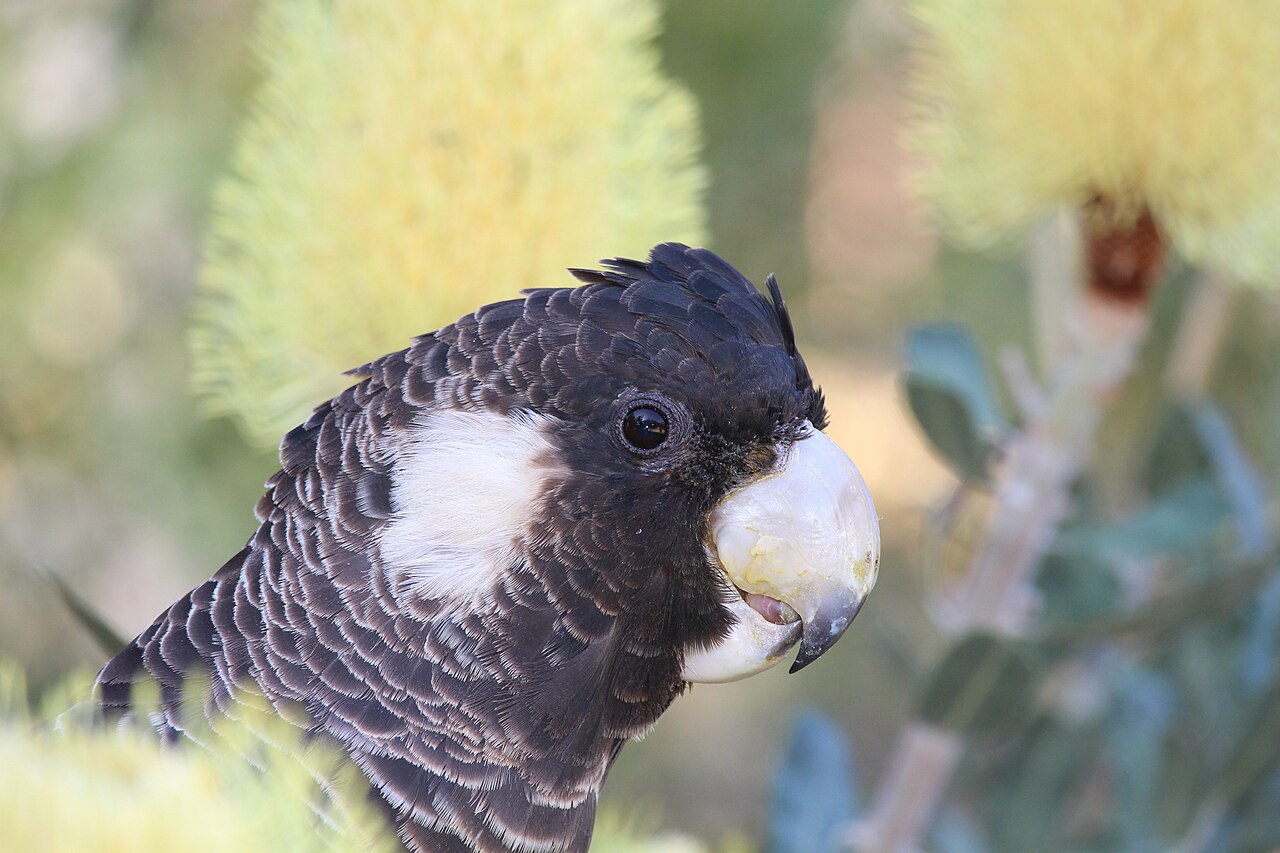
Carnaby's black cockatoo (Zanda latirostris) is one of two white-cheeked black cockatoos, and the way to tell it from Baudin's is the bill: Carnaby's is shorter and deeper, built for cracking hard banksia and hakea nuts, while Baudin's is longer and narrower for extracting marri seeds. The big white cheek patch shows clearly in the photograph. It lives only in south-western Western Australia, breeding in wheatbelt eucalypt woodland and moving to the coast in the non-breeding season to feed in banksia woodland and heath. It feeds on the seeds of banksias, hakeas and other proteaceous shrubs, and on insect larvae. Clearing of both its breeding woodland and its coastal feeding grounds has cut numbers steeply, and flocks now commute long distances between the two. The IUCN Red List classifies Carnaby's black cockatoo as Endangered.
Little corella
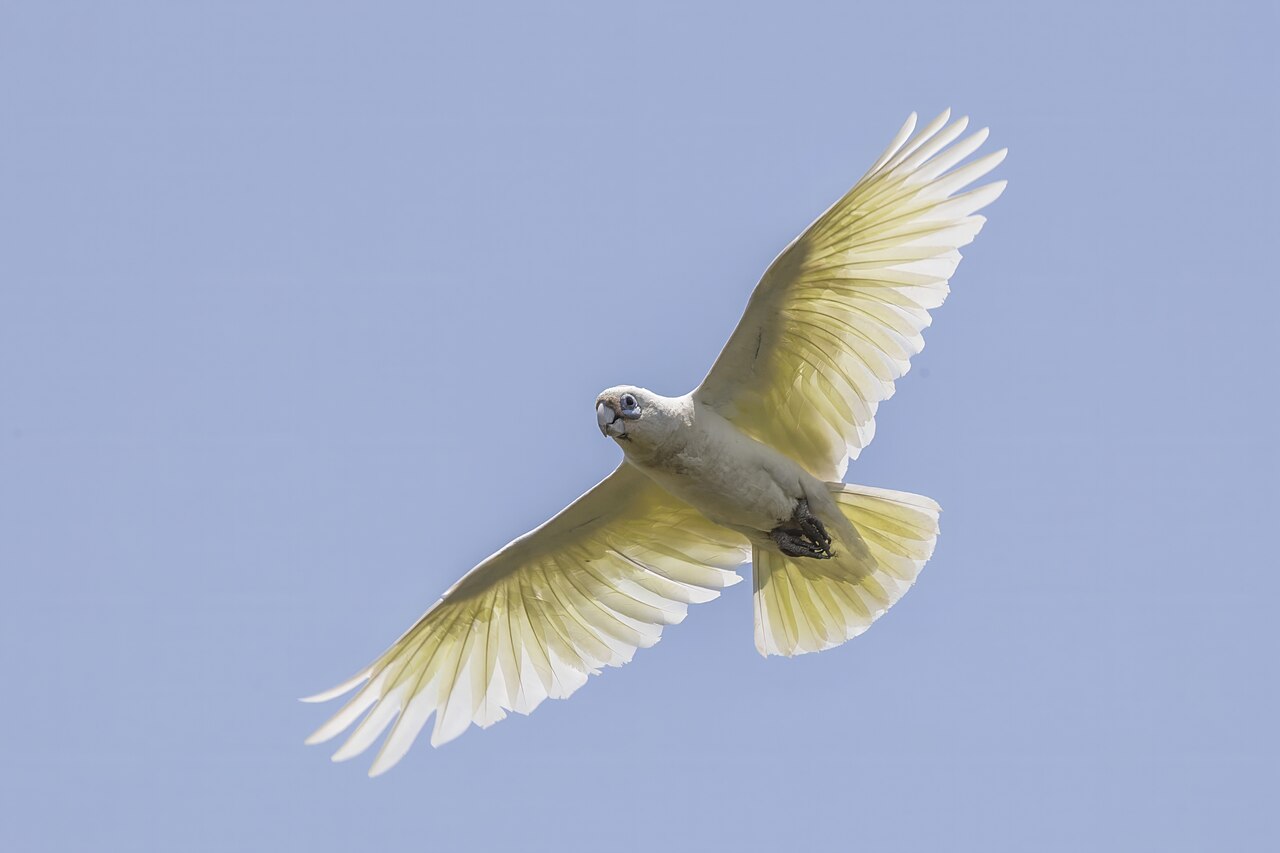
The little corella (Cacatua sanguinea) is a small, short-billed white cockatoo with a blue-grey eye-ring, a pink blush between the eye and the bill, and a lemon wash under the wings and tail that flashes in flight. It is widespread across mainland Australia and southern New Guinea, in grasslands, savanna, farmland and along watercourses. Little corellas are champion ground-feeders, digging for roots, bulbs and seeds, and in the dry season they gather in staggering flocks of thousands that swirl over waterholes at dawn. They are famously playful — sliding down roofs, swinging from wires and powerlines, and tumbling in flight — and their chattering chorus is a signature sound of the outback. Adaptable and numerous, the species thrives around farms and towns. The IUCN Red List classifies the little corella as Least Concern.
Long-billed corella
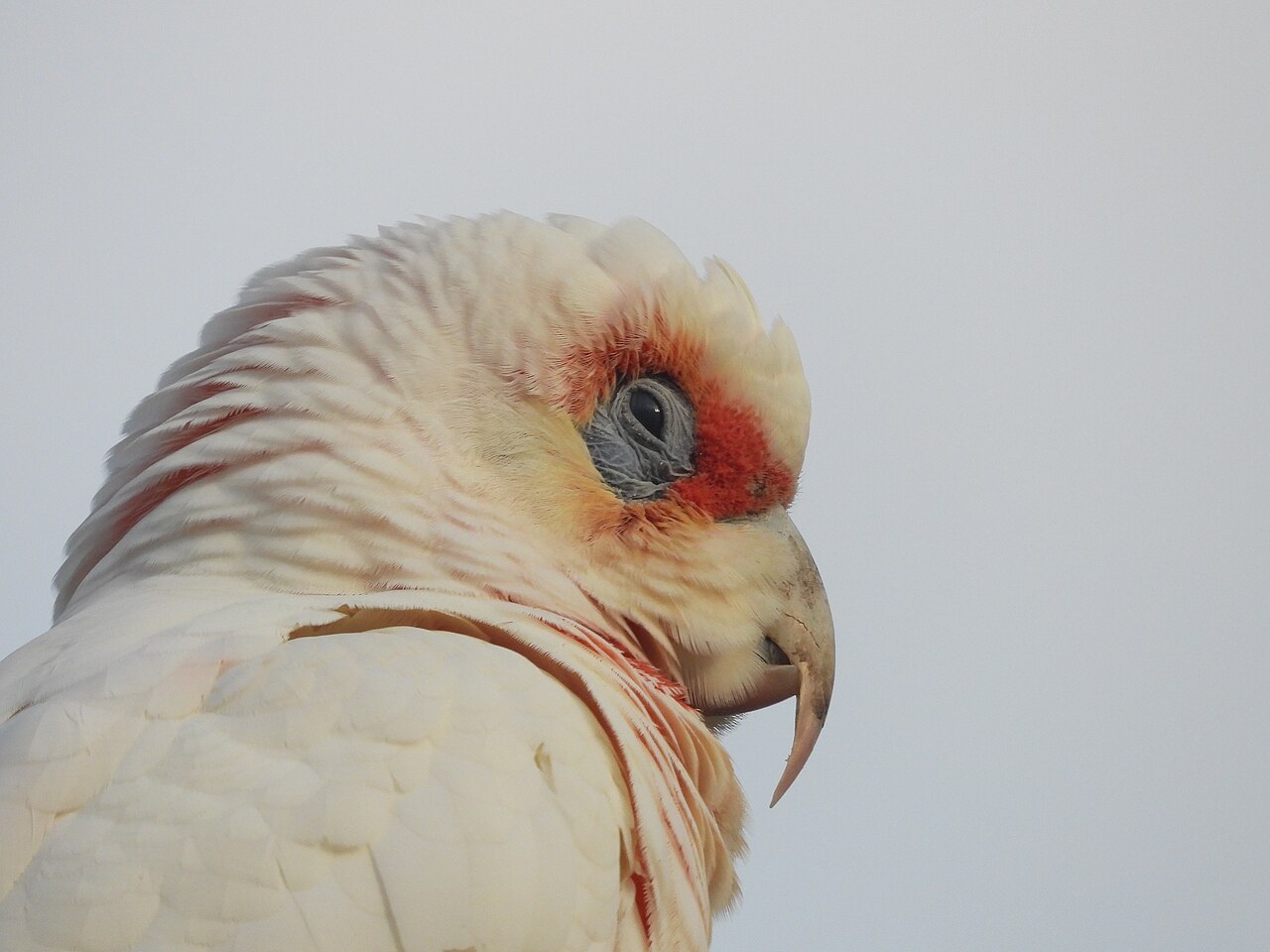
The long-billed corella (Cacatua tenuirostris) is the digging specialist among corellas: its upper bill is elongated into a slender point, an adaptation for excavating roots, bulbs and corms from the ground. It is white, with red-orange colouring around the face and a red band across the throat, and a blue-grey eye-ring. Its home is the grasslands and open woodland of south-eastern Australia, centred on Victoria and southern New South Wales. It feeds largely on the ground, using that long bill to unearth the bulbs of introduced onion grass as well as native roots and seeds, and it also strips grain. Sociable and noisy, it gathers in large flocks and shares the little corella's love of aerial play. The IUCN Red List classifies the long-billed corella as Least Concern, and its range has expanded with farmland.
Tanimbar corella
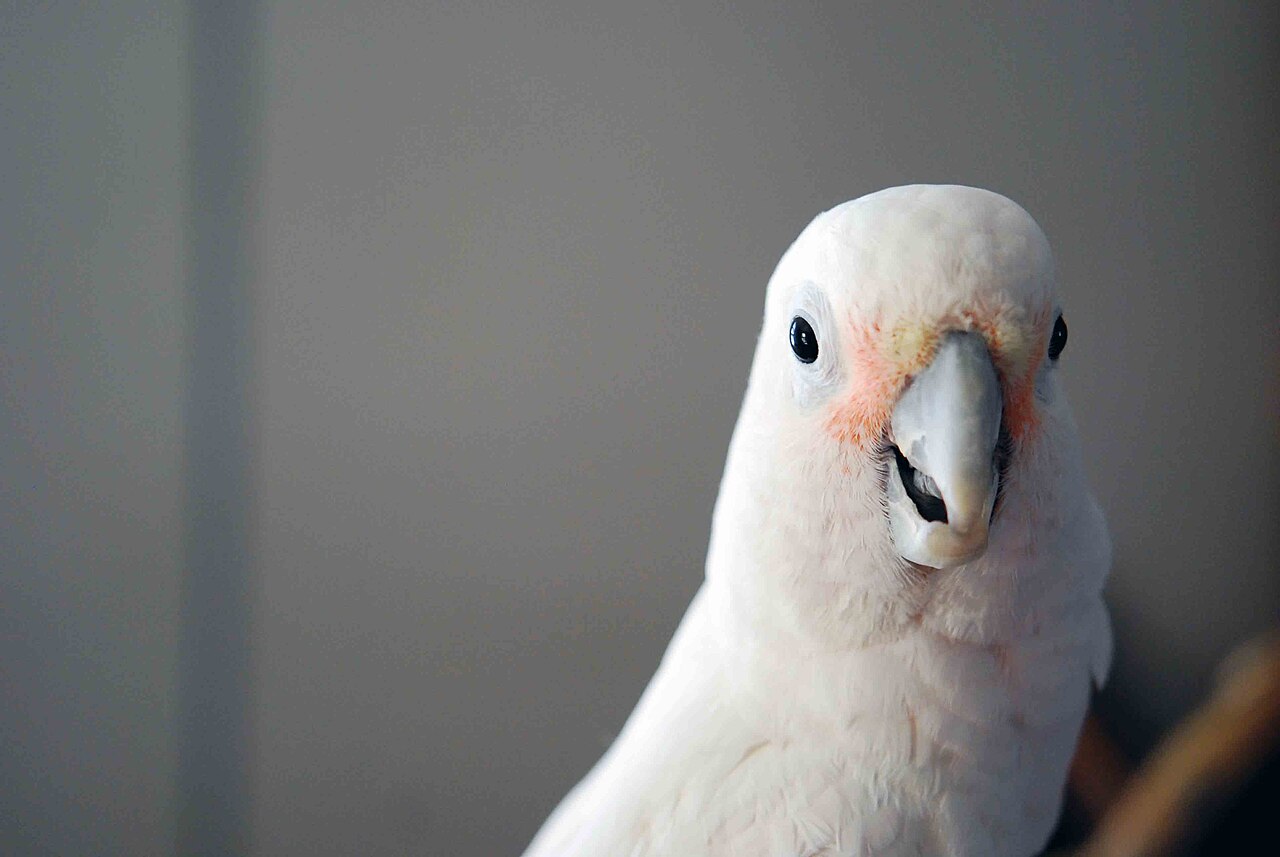
The Tanimbar corella (Cacatua goffiniana), better known to bird keepers as Goffin's cockatoo, is one of the smallest white cockatoos: white plumage, a short crest, a pale horn-coloured bill and salmon-pink lores — the patch between eye and bill that shows clearly in the photograph. It lives only on Indonesia's remote Tanimbar Islands, in forest, forest edge and cultivated land around villages. It feeds on seeds, nuts, fruit, berries and insects. In aviaries and laboratories it has become famous as one of the most inventive tool-users among birds, spontaneously making and using tools and solving multi-step puzzles, despite never using tools in the wild. Trapping for the pet trade removed large numbers from its small island range. The IUCN Red List classifies the Tanimbar corella as Near Threatened.
How to choose
Start with the real decision: who will use this, where, how often, and what would make the choice unsafe or disappointing? The following checks keep the shortlist practical.
- Identify by crest, eye-ring and bill shape first — white cockatoos are easy to confuse
- Watch from a distance and never approach nesting hollows in old trees
- Never buy wild-caught birds; the cage-bird trade threatens several species here
- Listen as well as look — most cockatoos announce themselves long before they land
- Use a field guide or app to confirm similar species (corellas and white cockatoos especially)
What to verify before you commit
Confirm the current specification, price or availability, terms, and seller or provider identity. For companies and services, request a written scope, named contact, references, and cancellation or warranty terms. For products, compare the unit price, compatibility, return window, and genuine support.
Editorial update
Cockatoos are the crested branch of the parrot family, found wild only in Australia, New Guinea, Indonesia, the Philippines and the Pacific islands. This guide focuses on identification and responsible observation — what each species looks like, where it lives and how it feeds — using well-established natural-history references. The family's smallest member, the cockatiel, is often kept and classified slightly apart, so it is noted here rather than given a full entry.
Frequently asked questions
How should I use this guide?
Use the shortlist to define what matters to you, then verify current price, availability, rules, credentials, or catalogue details at the source before you decide.
Is this a fixed ranking?
No. The refreshed page is an editorial starting point organised by fit and evidence. The right choice depends on your use case, location, budget, and timing.
When will this page be updated?
VisitBest reviews time-sensitive details when reliable public information changes. Send corrections or newer source links to visitbest10@gmail.com.
Keep exploring
Lizard Species Guide: Major Groups, Habitats and Identification
Learn the major lizard groups, the features that distinguish them, and how to observe wild reptiles without disturbing them.
Game Birds: Species Groups, Habitats and Responsible Observation
An introductory guide to pheasants, partridges, quail, grouse, wild turkey, guinea fowl, and commonly included waterfowl.

Labrador Dog Price in India: Real Cost, Care and Responsible Adoption
Understand why Labrador puppy prices vary and budget for lifelong food, veterinary care, training, exercise, grooming, travel, and emergencies.