
VisitBest guide
Famous Punjabi Singers: 15 Legendary Voices From Folk Roots to Global Charts
From Surinder Kaur, Gurdas Maan and Amar Singh Chamkila to Diljit Dosanjh, Sidhu Moose Wala, AP Dhillon, Karan Aujla and Shubh — 15 famous Punjabi singers…
In this guide
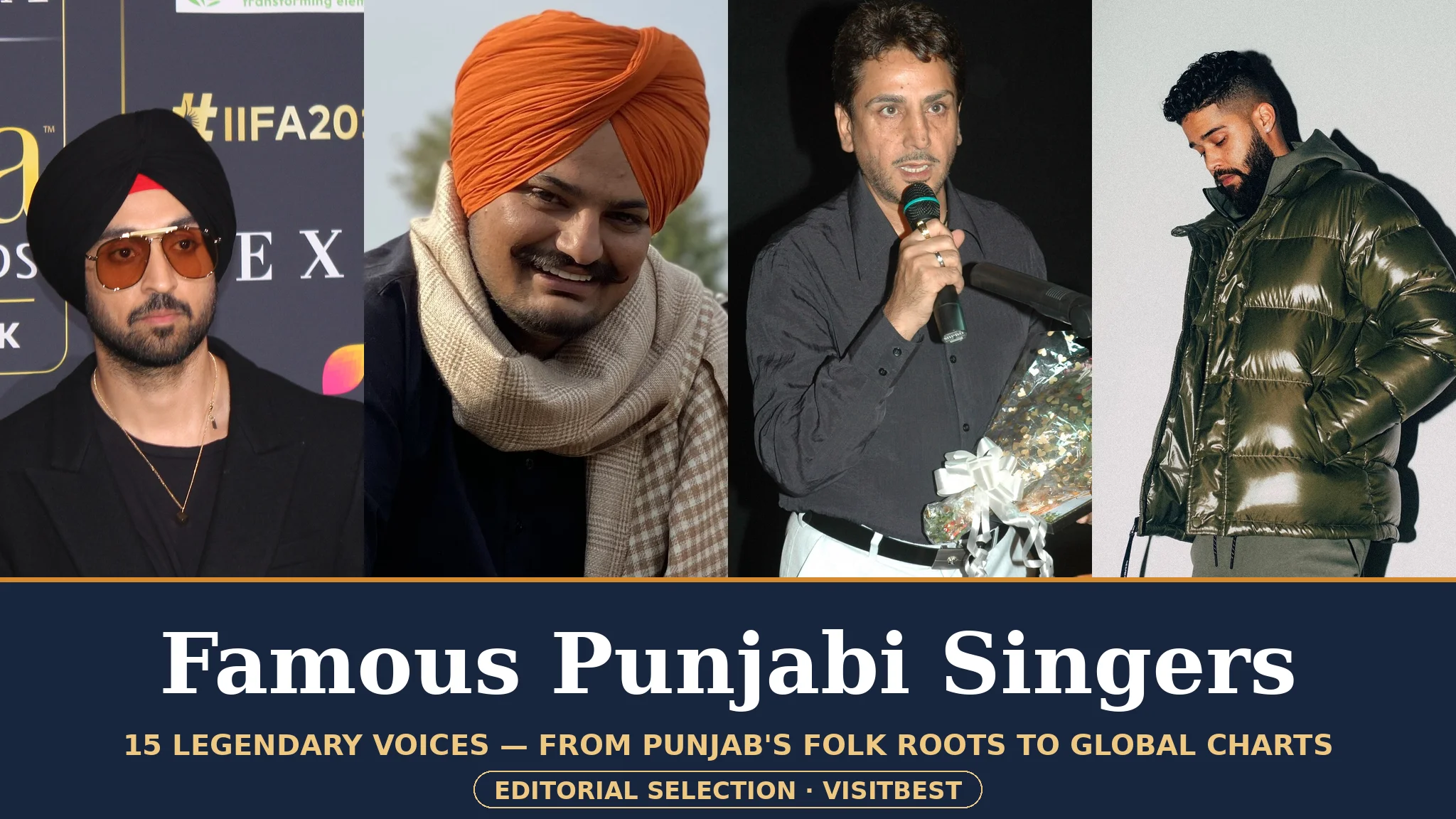
The most famous Punjabi singers are Surinder Kaur, Amar Singh Chamkila, Kuldeep Manak, Gurdas Maan, Hans Raj Hans, Daler Mehndi, Sukhbir, Babbu Maan, Diljit Dosanjh, Sidhu Moose Wala, Ammy Virk, Jasmine Sandlas, AP Dhillon, Karan Aujla and Shubh. Between them they cover a century of Punjabi music, from folk songs first preserved on radio to Punjabi tracks now recorded in Canada and streamed around the world.
This guide profiles all fifteen in the order they arrived: the legends who fixed the folk repertoire in the record books, the pop-era stars who took bhangra global in the 1990s, and the streaming generation that turned Brampton and Surrey into Punjabi music capitals. Each profile is kept short, with the key facts in bullets so the story of every singer is easy to scan.
Quick Answer — Famous Punjabi Singers at a Glance
- Surinder Kaur — the "Nightingale of Punjab", who first carried Punjabi folk song to a mass audience on radio.
- Amar Singh Chamkila — the cassette-era superstar whose duets with Amarjot made him the best-selling Punjabi singer of the 1980s.
- Kuldeep Manak — the "King of Kaliyan", master of the long narrative folk ballad.
- Gurdas Maan — the singer-songwriter whose own writing has anchored Punjabi music since 1980.
- Hans Raj Hans — the Sufi and folk voice who took Punjabi devotional singing to concert halls worldwide.
- Daler Mehndi — the bhangra-pop pioneer of "Tunak Tunak Tun", a global hit before social media existed.
- Sukhbir — the "Prince of Bhangra", whose 1990s albums fused bhangra with rap, reggae and techno.
- Babbu Maan — the writer-singer whose plain-spoken songs about rural Punjab built a fiercely loyal audience.
- Diljit Dosanjh — the biggest Punjabi live draw in the world today, from Coachella to the Met Gala.
- Sidhu Moose Wala — the streaming era's defining voice, whose songs outlived him to top global charts.
- Ammy Virk — the singer who became one of Punjabi cinema's most bankable leading men.
- Jasmine Sandlas — the California-raised singer whose voice powers Punjabi hits and Bollywood soundtracks alike.
- AP Dhillon — the Gurdaspur-born, Canada-based star behind "Brown Munde" and "Excuses".
- Karan Aujla — the songwriter-turned-headliner whose 2025 album P-Pop Culture broke Punjabi chart records in Canada.
- Shubh — the low-profile Brampton singer who went from a first upload in 2021 to Billboard charts within two years.
The 15 Singers in Summary
| Singer | Era | Known for |
|---|---|---|
| Surinder Kaur | Legends | Pioneering Punjabi folk singing on radio and record |
| Amar Singh Chamkila | Legends | Best-selling cassette-era duets with Amarjot |
| Kuldeep Manak | Legends | Kali ballads such as "Tere Tille Ton" |
| Gurdas Maan | Legends | Self-written classics from "Dil Da Mamla Hai" onwards |
| Hans Raj Hans | Legends | Sufi and folk singing; the Padma Shri in 2008 |
| Daler Mehndi | Pop Era | "Bolo Ta Ra Ra" and the worldwide "Tunak Tunak Tun" |
| Sukhbir | Pop Era | "Ishq Tera Tadpave (Oh Ho Ho Ho)" and bhangra fusion |
| Babbu Maan | Pop Era | "Mitran Di Chhatri" and uncompromising self-written songs |
| Diljit Dosanjh | Streaming Generation | Coachella 2023, record-breaking stadium tours, film stardom |
| Sidhu Moose Wala | Streaming Generation | "So High", "295" and the album Moosetape |
| Ammy Virk | Streaming Generation | Songs such as "Wang Da Naap" and a leading-man film career |
| Jasmine Sandlas | Streaming Generation | "Yaar Na Miley", "Illegal Weapon", "Taras" and "Nasha" |
| AP Dhillon | Streaming Generation | "Brown Munde", "Excuses" and The Brownprint |
| Karan Aujla | Streaming Generation | "Tauba Tauba" and the record-breaking P-Pop Culture |
| Shubh | Streaming Generation | "We Rollin", "Cheques", Sicario and "Supreme" |
How Punjabi Music Travelled From Village Fairs to Global Charts
Punjabi recorded music begins with radio. In the 1940s a teenage Surinder Kaur sang folk songs live on Lahore Radio, and for the first time the wedding songs, laments and love lyrics of Punjab's villages reached listeners far beyond the fairground. The singers who followed her spent decades fixing that oral repertoire onto records before it could be lost.
Each generation since has ridden a new technology. Cassettes made Chamkila a phenomenon in the 1980s; satellite television and the music video carried Daler Mehndi and Sukhbir to the diaspora in the 1990s; and streaming moved the industry's centre of gravity to Canada, where AP Dhillon, Karan Aujla and Shubh now record for an audience measured in billions of plays.
The Legends Who Built Punjabi Music
The five singers in this section worked before the internet, most of them before television reached Punjab's villages. Their job was preservation as much as performance: the folk repertoire they recorded is still the foundation every younger singer on this list builds on.
1. Surinder Kaur
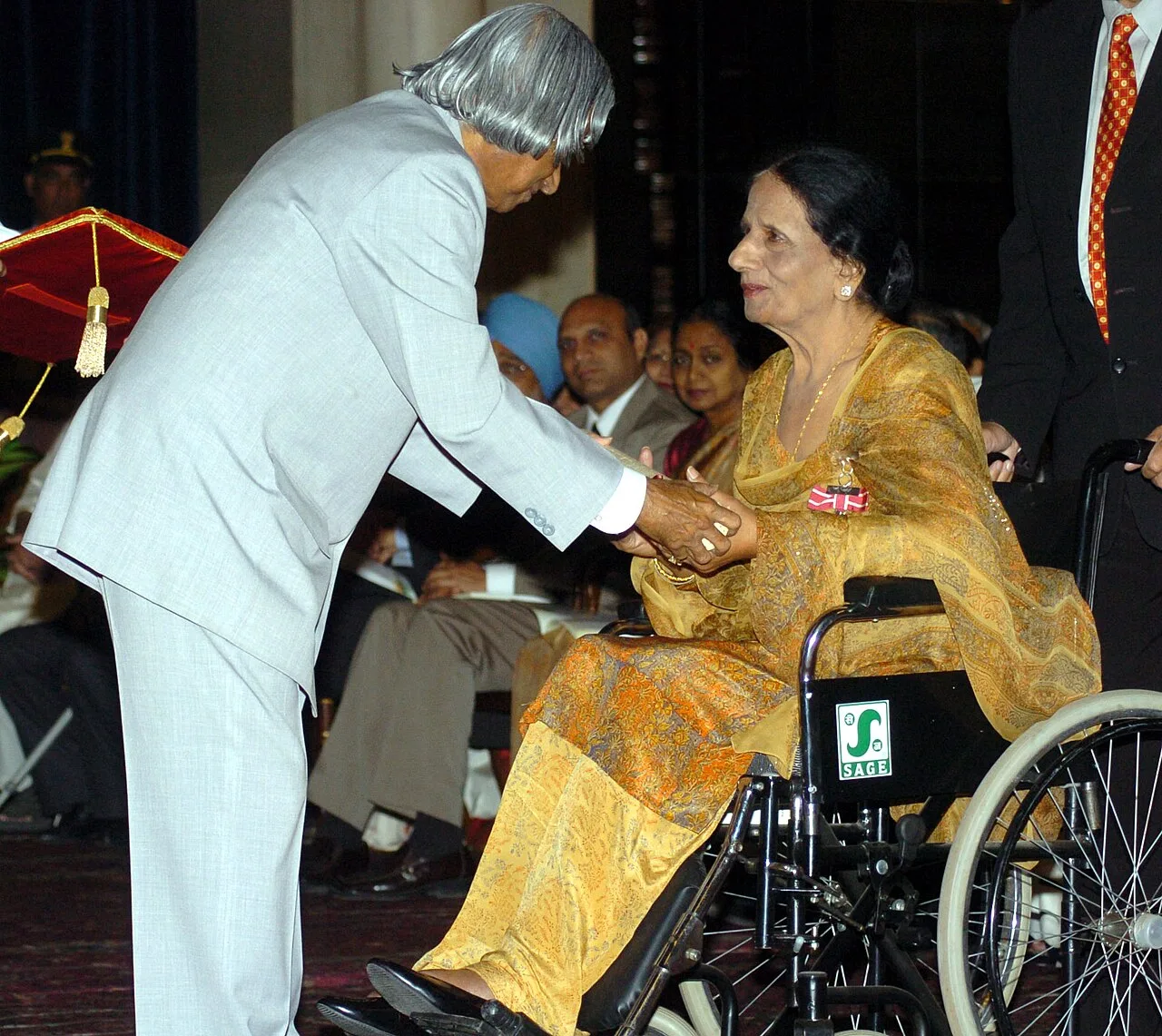
Quick highlights:
- Known as the "Nightingale of Punjab" (Punjab di Koyal)
- First sang live on Lahore Radio in August 1943, as a teenager
- Recorded more than 2,000 songs, as widely reported
- Received the Sangeet Natak Akademi Award in 1984 and the Padma Shri in 2006
Surinder Kaur (25 November 1929 – 14 June 2006) is credited with pioneering and popularising the Punjabi folk song. Her Lahore Radio broadcasts from 1943 took songs that had belonged to village weddings and family gatherings and gave them a permanent recorded form, and her versions of "Maavan te Dheeyan", "Madhaniyan", "Lathe Di Chadar" and "Bajre Da Sitta" remain the ones every later singer is measured against.
Between 1948 and 1952 she also sang playback for Hindi films, beginning with Shaheed (1948), before devoting herself to Punjabi folk music. The Padma Shri arrived in 2006, months before her death in New Jersey on 14 June 2006, and almost every singer in this guide learned the folk repertoire through her recordings.
| Born | 25 November 1929, Lahore; died 14 June 2006, New Jersey, USA |
| Known for | Pioneering and popularising Punjabi folk singing |
| Signature songs | "Maavan te Dheeyan", "Madhaniyan", "Lathe Di Chadar", "Bajre Da Sitta", "Kaala Doria" |
2. Amar Singh Chamkila
Quick highlights:
- Born Dhani Ram on 21 July 1960 in Dugri, Ludhiana
- Shot to fame singing duets with his wife Amarjot
- The best-selling Punjabi artist of the cassette era, famous for packed live akharas
- His life was dramatised in the 2024 Netflix film Amar Singh Chamkila, starring Diljit Dosanjh
Amar Singh Chamkila built his career on the live stage. Performing with Amarjot, he played hundreds of village akharas a year at his peak, and his cassettes sold in quantities no Punjabi singer had approached. Songs such as "Pehle Lalkare Naal", "Baba Tera Nankana" and "Talwar Main Kalgidhar Di" mixed devotion, satire and earthy humour in a direct language that official radio had kept at arm's length.
Chamkila and Amarjot were shot dead in Mehsampur on 8 March 1988, a killing that remains unsolved. His standing has only grown since: Imtiaz Ali's 2024 film Amar Singh Chamkila introduced him to a new generation, and his recordings still anchor the folk end of Punjabi music.
| Born | 21 July 1960, Dugri, Ludhiana; died 8 March 1988, Mehsampur |
| Known for | Cassette-era folk duets performed with Amarjot |
| Signature songs | "Pehle Lalkare Naal", "Baba Tera Nankana", "Talwar Main Kalgidhar Di", "Jija Lak Minle" |
3. Kuldeep Manak
Quick highlights:
- Born 15 November 1951 in Latifpura, Jalandhar; died 30 November 2011
- Known as Kaliyan da Badshah, the King of Kaliyan
- His kali "Tere Tille Ton" is among the most celebrated recordings in Punjabi music
- Sang epic stories — Heer, Mirza Sahiban, Dulla Bhatti — in full narrative form
Kuldeep Manak specialised in the kali, the long-form Punjabi ballad that tells a complete story in song. Where a pop single lasts four minutes, a kali unfolds like a chapter, and Manak's voice — trained, deliberate and instantly recognisable — made him its defining performer. "Tere Tille Ton", "Maa Hundi Ae Maa" and "G.T. Road" remain reference points for folk singers.
Manak recorded prolifically from the late 1960s onwards, carrying the tales of Heer-Ranjha, Mirza-Sahiban and Dulla Bhatti to listeners who might never have heard them told in full. He is the clearest link on this list between the travelling balladeers of old Punjab and the recording age.
| Born | 15 November 1951, Latifpura, Jalandhar; died 30 November 2011 |
| Known for | Kali ballads and narrative folk singing |
| Signature songs | "Tere Tille Ton", "Maa Hundi Ae Maa", "G.T. Road" |
4. Gurdas Maan
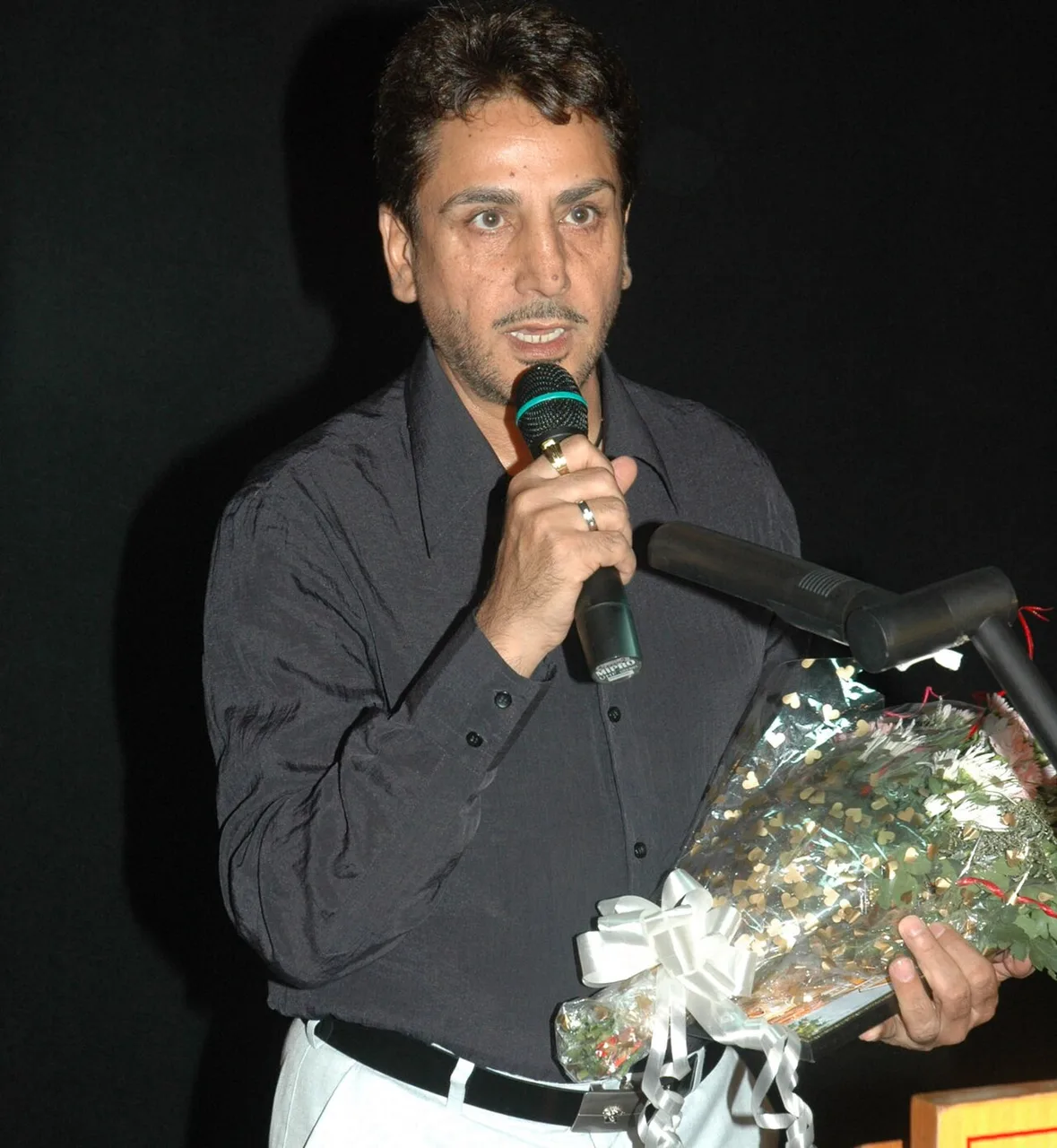
Quick highlights:
- Born 4 January 1957 in Giddarbaha, Punjab
- Breakthrough came with "Dil Da Mamla Hai", performed on national television in 1980
- Writes the great majority of his own songs
- Starred as the poet Waris Shah in Waris Shah: Ishq Daa Waaris (2006) and received the Padma Shri
Gurdas Maan is the singer-songwriter at the centre of modern Punjabi music. A self-written song, "Dil Da Mamla Hai", performed on Doordarshan in 1980, made him a star overnight, and he followed it with a catalogue that treats Punjabi poetry as living material: "Mamla Gadbad Hai", "Challa" and "Ki Banu Duniya Da" are sung at weddings and protests alike.
His film work peaked with Waris Shah: Ishq Daa Waaris (2006), in which he played the Sufi poet himself and won the National Film Award for Best Male Playback Singer. More than four decades after his debut he remains the figure younger Punjabi artists cite most often as the standard to meet.
| Born | 4 January 1957, Giddarbaha, Punjab |
| Known for | Self-written Punjabi songs and the title role in Waris Shah: Ishq Daa Waaris |
| Signature songs | "Dil Da Mamla Hai", "Mamla Gadbad Hai", "Challa", "Ki Banu Duniya Da" |
5. Hans Raj Hans
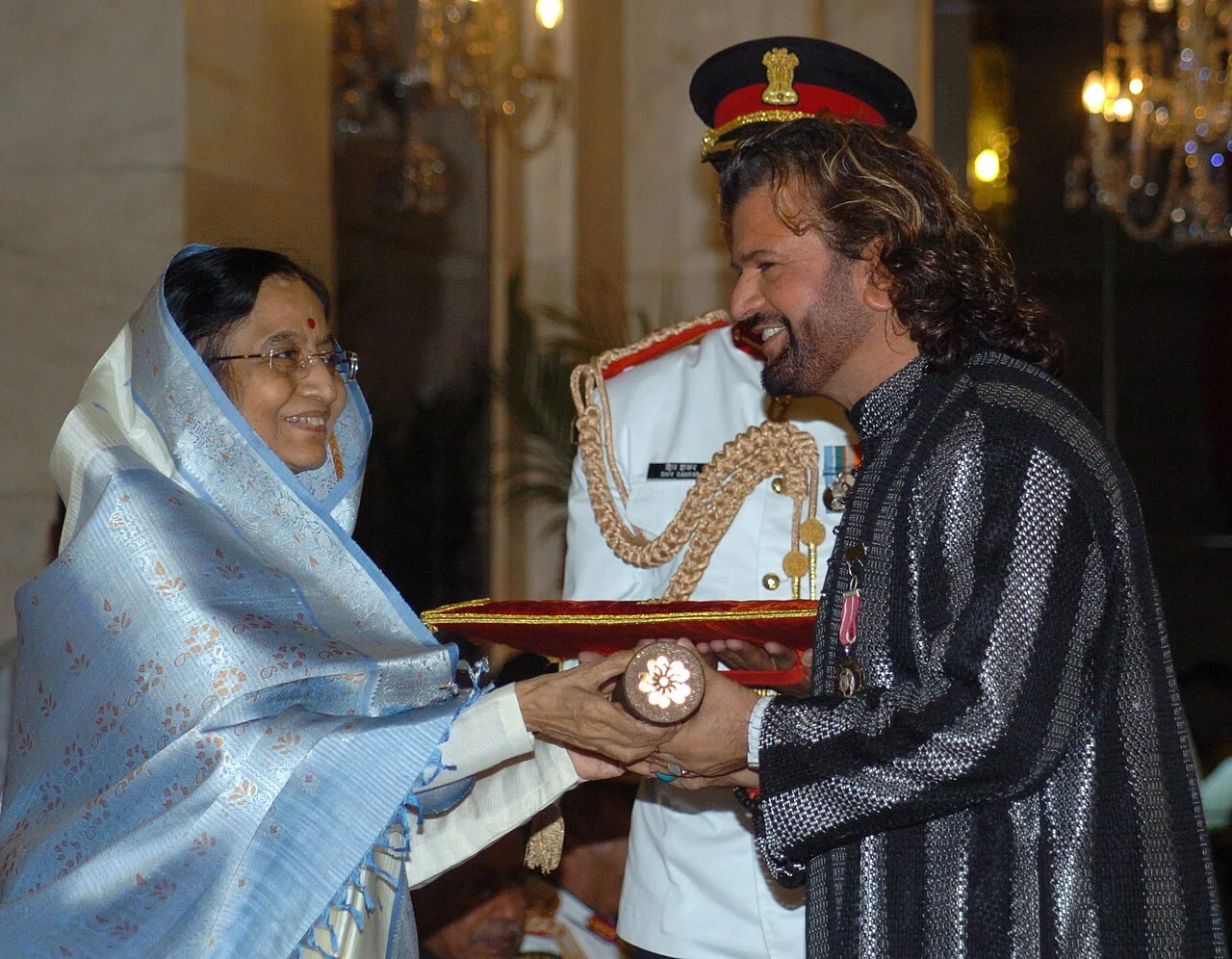
Quick highlights:
- Born in Shafipur village, Jalandhar district
- Known for folk, devotional and Sufi singing, including the verses of Bulleh Shah
- Sang with Nusrat Fateh Ali Khan for the film Kachche Dhaage (1999)
- Received the Padma Shri in 2008
Hans Raj Hans built his reputation on the oldest material in this guide: Punjabi folk songs, devotional verse and the Sufi poetry of Bulleh Shah and Baba Farid. His controlled, classically grounded voice carried that repertoire from the mela stage to concert halls in Britain, Canada and Pakistan, where he performed in Lahore in 1997.
Mainstream audiences met the same voice through film and pop work — "Dil Chori Sada Ho Gaya" became a party staple — without any change to the style that made him. The Padma Shri in 2008 recognised a career spent treating Punjabi folk and Sufi singing as a discipline, not a novelty.
| Born | Shafipur village, Jalandhar district, Punjab |
| Known for | Punjabi folk, devotional and Sufi singing |
| Signature songs | "Tera Ishq", "Sili Sili Aundi Ae Hawa", "Dil Chori Sada Ho Gaya", "Nit Khair Manga" |
The Pop Era — Bhangra Goes Global
In the 1990s Punjabi music learned showmanship. Satellite television, the album video and a wealthy diaspora audience rewarded singers who thought like pop stars, and these three men defined the sound of every Punjabi wedding playlist since.
6. Daler Mehndi
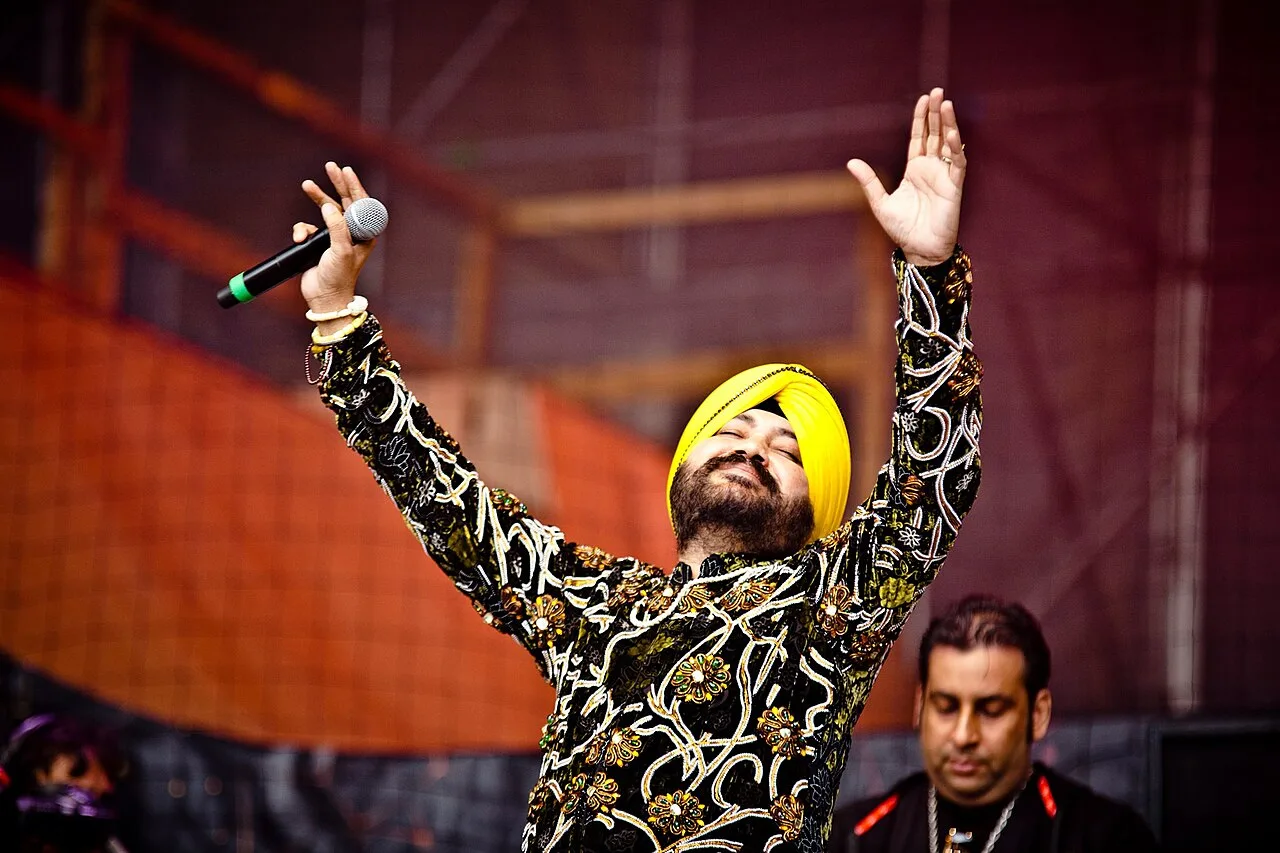
Quick highlights:
- Born 18 August 1967 in Patna, Bihar, and raised on Punjabi folk and Sufi music
- His debut album Bolo Ta Ra Ra (1995) sold in the millions
- "Tunak Tunak Tun" (1998) became a worldwide hit years before social media
- Often credited with creating the bhangra-pop genre as a mainstream category
Daler Mehndi arrived with a formula nobody else had tried at scale: folk bhangra sung at full throttle, dressed in jewel-coloured robes and turbans, and sold through spectacular videos. Bolo Ta Ra Ra made him India's biggest-selling pop artist of the mid-1990s, and "Ho Jayegi Balle Balle" confirmed that the formula travelled.
His most durable record is "Tunak Tunak Tun" (1998), made with early chroma-key technology and spread by the young internet until it became a global meme and a wedding standard on several continents. It remains the clearest proof that a Punjabi song needs no translation to conquer a dancefloor.
| Born | 18 August 1967, Patna, Bihar |
| Known for | Creating mainstream bhangra pop |
| Signature songs | "Bolo Ta Ra Ra", "Tunak Tunak Tun", "Ho Jayegi Balle Balle", "Dardi Rab Rab" |
7. Sukhbir
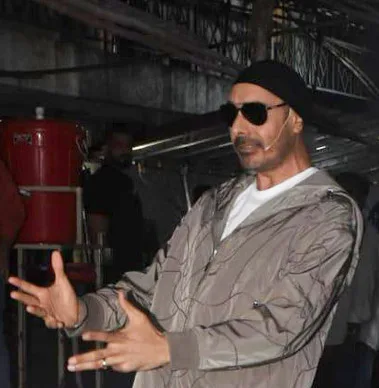
Quick highlights:
- Born 9 November 1969 in Jalandhar; based in Dubai
- Dubbed the "Prince of Bhangra" for albums that fused bhangra with rap, reggae and techno
- "Ishq Tera Tadpave (Oh Ho Ho Ho)" is among the most played Punjabi party songs ever recorded
- A fixture of the diaspora wedding and concert circuit for three decades
Sukhbir Singh approached bhangra as an international producer would. Recording in Dubai and London, he wrapped Punjabi vocals around rap verses, reggae rhythms and electronic production at a time when most Punjabi albums were still made for the local market, and the diaspora adopted him as its own party singer.
"Ishq Tera Tadpave", universally known by its shout of "Oh Ho Ho Ho", has outlasted the album era entirely: it is still the song DJs reach for when a floor needs filling. Sukhbir's career is the bridge between the folk legends above and the streaming stars below.
| Born | 9 November 1969, Jalandhar; based in Dubai |
| Known for | Bhangra fusion albums and the diaspora party circuit |
| Signature songs | "Ishq Tera Tadpave (Oh Ho Ho Ho)", "Gal Ban Gayi", "Hayo Rabba" |
8. Babbu Maan
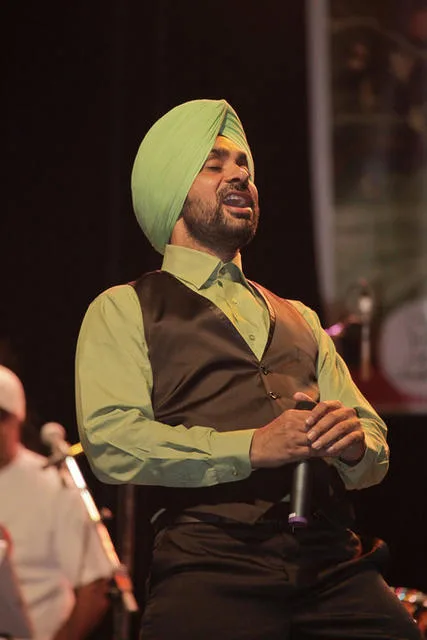
Quick highlights:
- Born 29 March 1975 in Khant Maanpur, Fatehgarh Sahib district
- Writes and composes nearly all of his own material
- His album Saaun Di Jhadi (2001) carried the enduring hit "Mitran Di Chhatri"
- Also leads Punjabi films, including Hashar (2008), which he wrote
Babbu Maan writes about the Punjab he grew up in — its farms, its politics, its emigration queues — in a voice that refuses polish. From his debut album Tu Meri Miss India (1999) through Saaun Di Jhadi (2001), he built a following that treats his concerts less as entertainment than as assembly, singing the words back line for line.
That independence defines him: he has kept control of his writing and production through every shift in the industry, and his songs about rural life and social pressure are quoted in Punjab the way proverbs are. Few singers anywhere command loyalty of this intensity.
| Born | 29 March 1975, Khant Maanpur, Fatehgarh Sahib district |
| Known for | Plain-spoken, self-written songs about rural Punjab |
| Signature songs | "Mitran Di Chhatri", "Tu Meri Miss India Hain", "Pakki Kanak", "Pyaas" |
The Streaming Generation
The seven singers in this section grew up with the internet, and most of them are based outside India. Their audience is counted in billions of streams rather than cassettes sold, and their careers run on a calendar of singles, albums and stadium tours that spans three continents.
9. Diljit Dosanjh
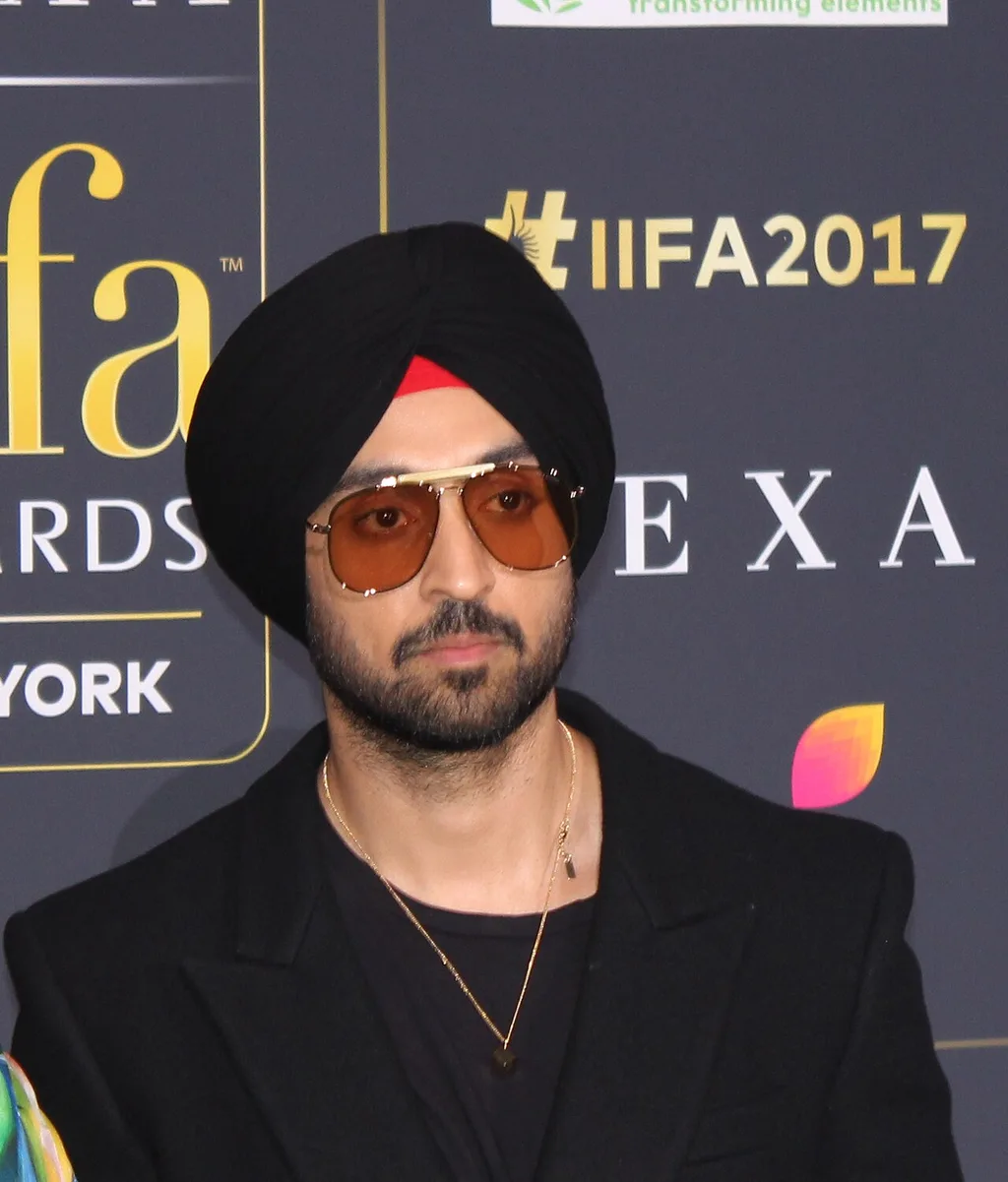
Quick highlights:
- Born 6 January 1984 in Dosanjh Kalan, Jalandhar district
- First Punjabi-language singer to perform at Coachella, in April 2023
- His Dil-Luminati tour (2024) sold out Toronto's Rogers Centre and Vancouver's BC Place
- Made his Met Gala debut in 2025 and released the album Aura the same year
Diljit Dosanjh has carried Punjabi music further into the global mainstream than anyone before him. The sequence is now familiar: Coachella in April 2023, a performance on The Tonight Show Starring Jimmy Fallon in June 2024, and a 2025 Met Gala appearance in a Prabal Gurung ensemble honouring Maharaja Bhupinder Singh of Patiala that Vogue readers voted the evening's best dressed.
The live numbers match the symbolism. His Dil-Luminati shows set records for a Punjabi artist in Canada, and his Aura tour reached India in the autumn of 2026 after runs overseas. Alongside the music he remains a leading man in Punjabi cinema and played Chamkila in the 2024 biopic — the streaming era's biggest star embodying the cassette era's.
| Born | 6 January 1984, Dosanjh Kalan, Jalandhar district |
| Known for | Global stadium tours, Coachella and a parallel film career |
| Signature songs | "Born to Shine", "G.O.A.T.", "Lover", "Patiala Peg", "Do You Know" |
10. Sidhu Moose Wala
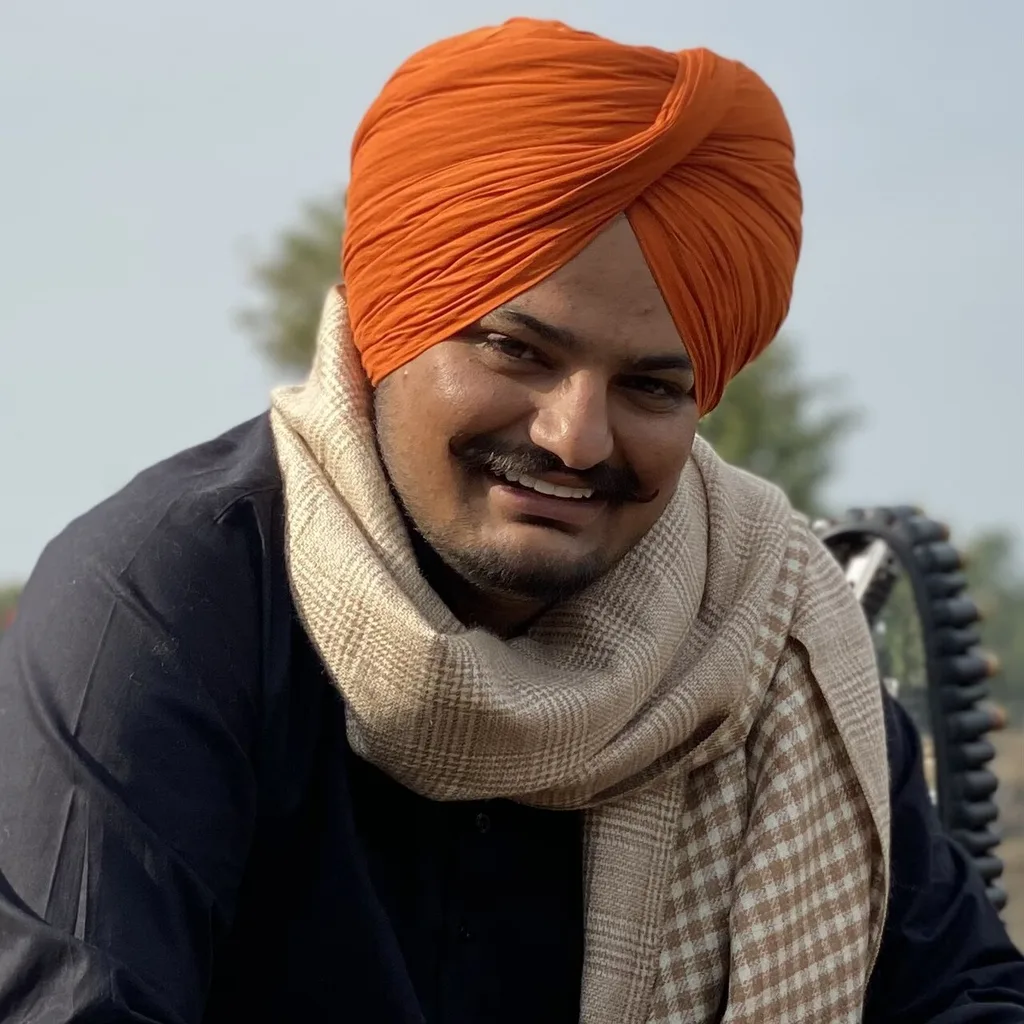
Quick highlights:
- Born Shubhdeep Singh Sidhu on 11 June 1993 in Moosa village, Mansa
- Wrote lyrics for other singers before his own breakthrough, "So High" (2017)
- His album Moosetape (2021) charted on the Billboard Canadian Albums chart
- Posthumous releases have continued to chart worldwide
Sidhu Moose Wala wrote from and about a specific place — Moosa village in Mansa district — in a mix of Punjabi pride, hip-hop bravado and, in songs such as "295", open social commentary. Moving to Brampton as a student, he built his audience on YouTube and streaming, and became the most-listened Punjabi artist of his era without radio or film support.
He was shot dead in Punjab on 29 May 2022, aged 28; the killing and its trial are covered separately in our report on the Sidhu Moose Wala murder case. His catalogue has kept growing after his death through carefully released recordings, and his streaming numbers remain among the largest in Punjabi music.
| Born | 11 June 1993, Moosa, Mansa; died 29 May 2022 |
| Known for | Punjabi hip-hop rooted in village life and social commentary |
| Signature songs | "So High", "295", "The Last Ride", "Levels", "Dollar" |
11. Ammy Virk
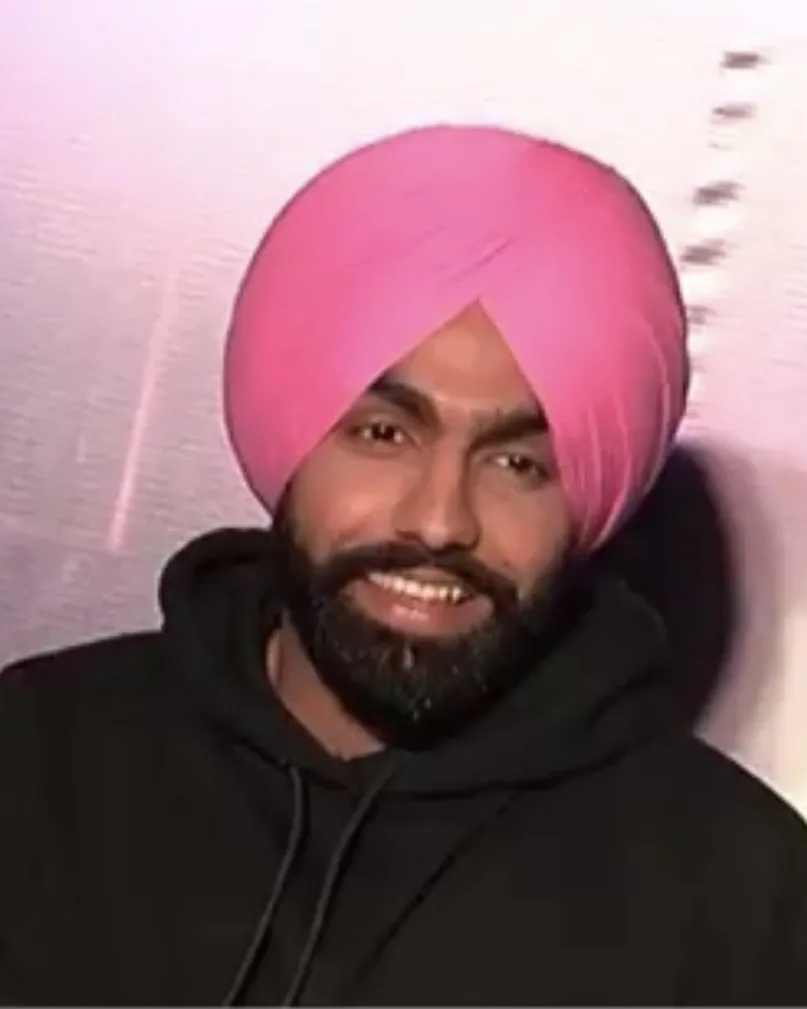
Quick highlights:
- Born Amninderpal Singh Virk on 11 May 1992 in Patiala
- Began as a singer with "Chandigarh Diyan Kudiyan" before acting took over
- Headlined the Nikka Zaildar series and the hit romance Qismat (2018)
- In 2024 he starred in Kudi Haryane Val Di and the Hindi film Bad Newz
Ammy Virk is the clearest example of the Punjabi singer-actor path done well. The songs came first — "Zindabaad Yaarian" and "Wang Da Naap" are still wedding standards — but from his mid-2010s film debut he built a second career as one of Punjabi cinema's most reliable leading men, carrying romances and comedies in equal measure.
He completed a decade in Punjabi films in 2025. His 2024 run showed the range: the cross-cultural romance Kudi Haryane Val Di at home, and a principal role opposite Vicky Kaushal in the Bollywood comedy Bad Newz — the same film carried by Karan Aujla's "Tauba Tauba".
| Born | 11 May 1992, Patiala |
| Known for | Singing and a leading-man career in Punjabi cinema |
| Signature songs | "Chandigarh Diyan Kudiyan", "Zindabaad Yaarian", "Wang Da Naap", "Haan Kargi" |
12. Jasmine Sandlas
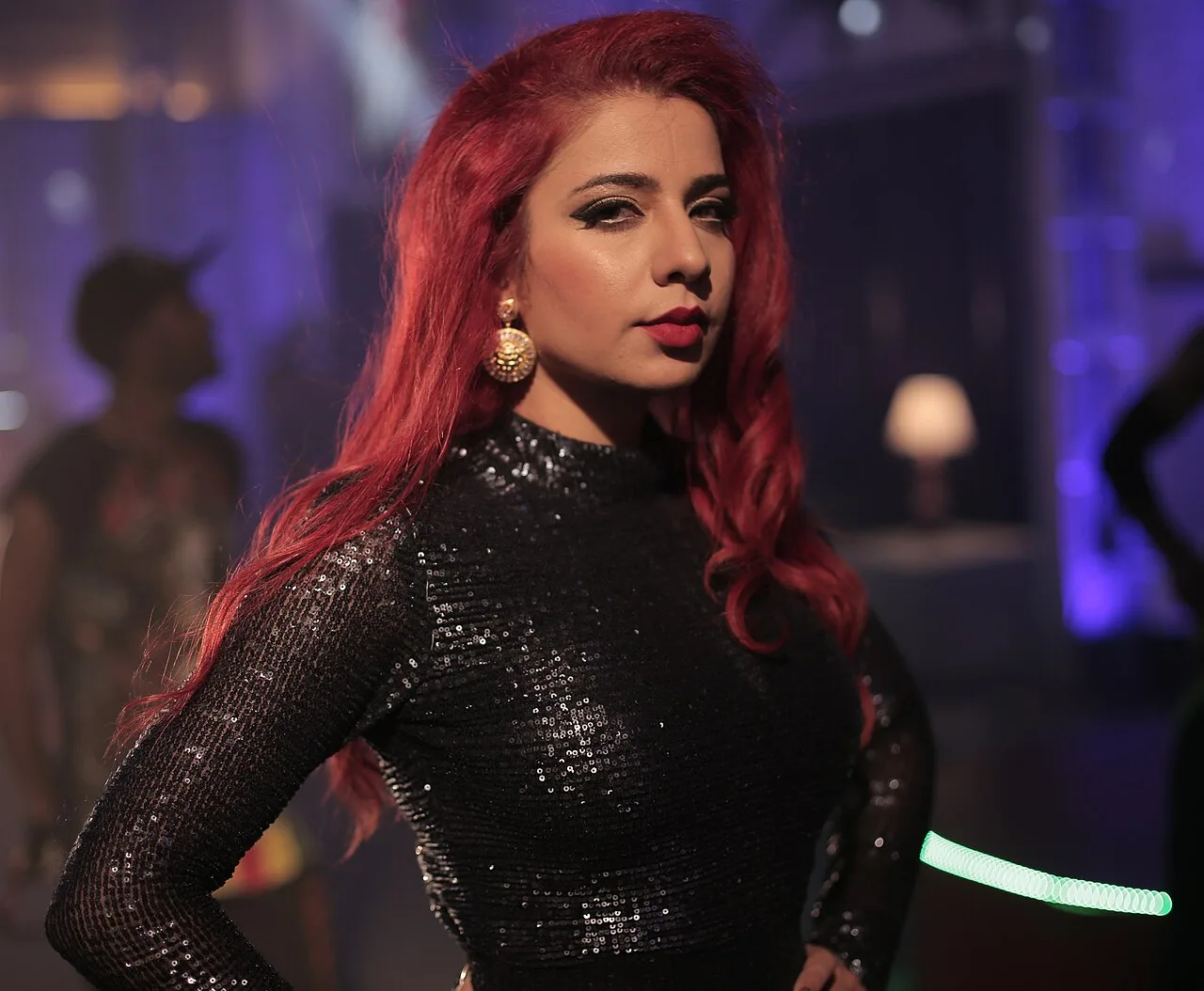
Quick highlights:
- Born 4 September 1985 in Jalandhar; raised in Stockton, California
- Bollywood playback debut with "Yaar Na Miley" in Kick (2014)
- "Illegal Weapon" and "Sip Sip", recorded with Garry Sandhu, became Punjabi pop standards
- Returned to Bollywood with "Taras" (Munjya, 2024) and "Nasha" (Raid 2, 2025)
Jasmine Sandlas sings with an American accent and a Jalandhar attitude, and the combination made her the most recognisable female voice in modern Punjabi pop. After early independent work including "Muskan" (2008), her Bollywood debut on Kick's "Yaar Na Miley" (2014) put that voice in front of a national audience.
Her recent run is a second peak. "Taras" in Munjya (2024) ended a four-year gap from Bollywood, "Nasha" in Raid 2 (2025) followed, and she has since been heard across the Dhurandhar soundtracks ("Shararat" among them) while releasing her own material, including "POLS", which she described as a rebirth, and touring India on her Dream Girl tour.
| Born | 4 September 1985, Jalandhar; raised in Stockton, California, USA |
| Known for | A Punjabi pop and Bollywood playback voice with a diaspora edge |
| Signature songs | "Yaar Na Miley", "Illegal Weapon", "Sip Sip", "Taras", "Nasha" |
13. AP Dhillon
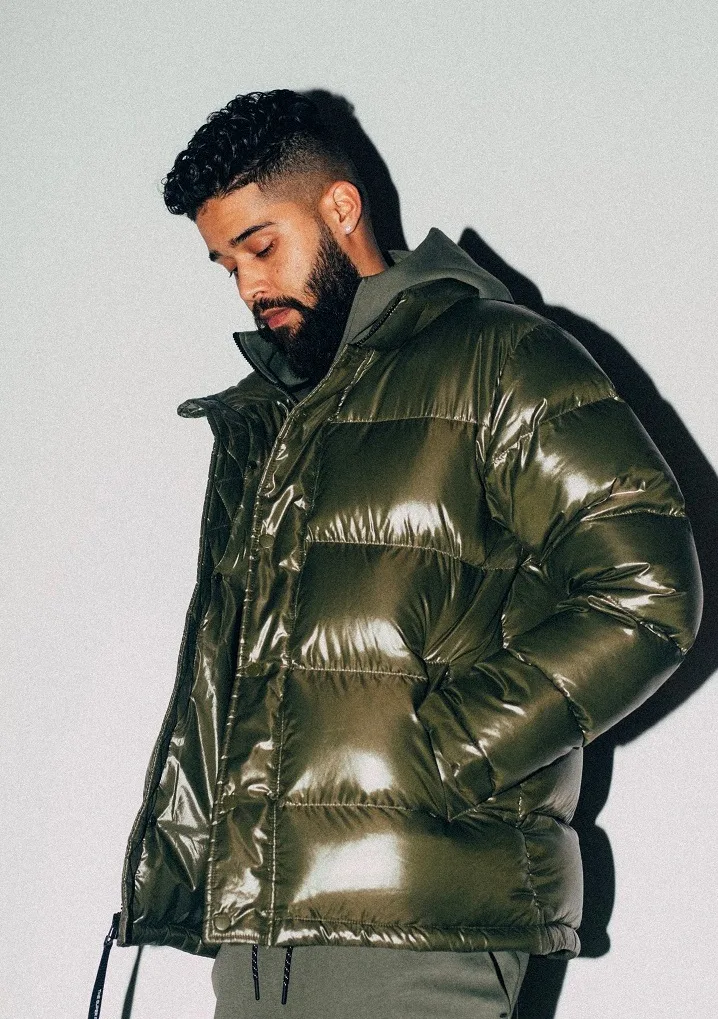
Quick highlights:
- Born Amritpal Singh Dhillon on 10 January 1993 in Gurdaspur; moved to Canada
- Built his sound with the Run-Up collective alongside Shinda Kahlon and Gurinder Gill
- "Brown Munde" (2020) and "Excuses" (2021) made him a streaming phenomenon
- First Punjabi-language artist to perform at Canada's Juno Awards, in 2023
AP Dhillon's music sounds like his biography: Punjabi lyrics over North American production, recorded in British Columbia for listeners in both places at once. Working through the independent Run-Up label, "Brown Munde" became an anthem for Punjabi students and workers abroad, and "Excuses" turned the recognition into record streaming numbers across India.
His scale since is documented rather than rumoured: a Prime Video docuseries, AP Dhillon: First of a Kind (2023), charting albums in Canada, and The Brownprint (2024), an EP released through Republic Records with collaborations including Gunna and Ayra Starr. In 2025 he paired with Anuv Jain on "Afsos" and with Shreya Ghoshal on "Thodi Si Daaru", extending the same sound into new audiences.
| Born | 10 January 1993, Gurdaspur; based in Canada |
| Known for | Melodic Punjabi pop-rap made in Canada for a global audience |
| Signature songs | "Brown Munde", "Excuses", "Insane", "Summer High", "With You" |
14. Karan Aujla
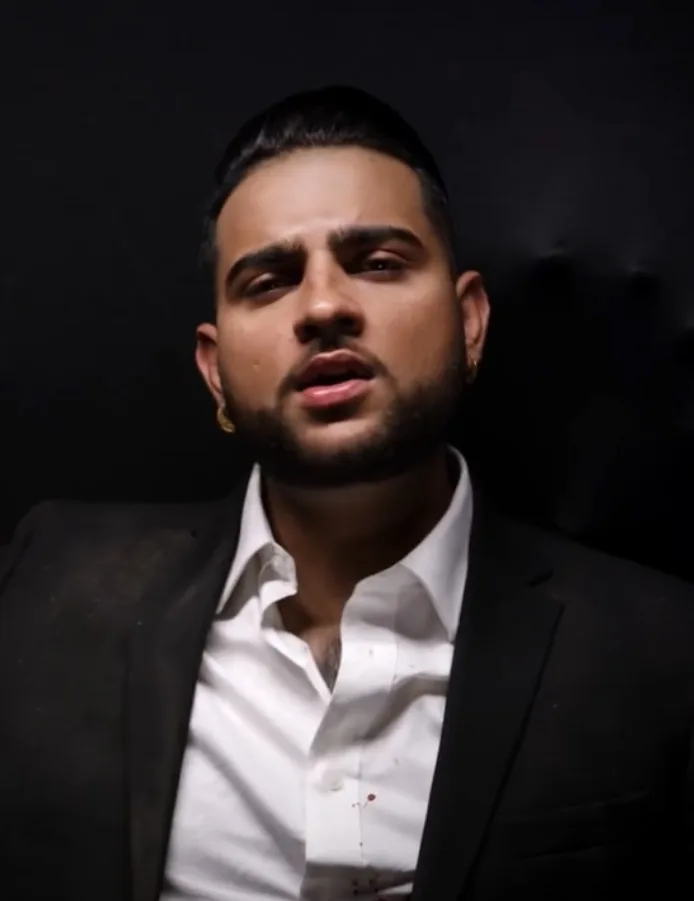
Quick highlights:
- Born Jaskaran Singh Aujla on 18 January 1997 in Ghurala, Ludhiana; based in Canada
- Started as a songwriter for other artists before "Don't Look" (2019) broke him as a singer
- Won the TikTok JUNO Fan Choice Award in 2024, a first for an artist of Punjabi descent
- His album P-Pop Culture (2025) set Punjabi chart records in Canada
Karan Aujla's pen came first: he wrote songs for established singers, reportedly including the title track of Diljit Dosanjh's G.O.A.T., before his own records took over. The albums tell the rise — Bacthafucup (BTFU) in 2021, then Making Memories (2023) with producer Ikky, which debuted at number five on the Billboard Canadian Albums chart, then a record for a Punjabi album.
The last two years moved him into the mainstream. "Tauba Tauba", written and sung for the film Bad Newz (2024), became a national hit in India, and P-Pop Culture (August 2025), again with Ikky, debuted at number three in Canada with all eleven tracks charting — the highest debut by a Punjabi-language album there — while topping streaming charts in India and Canada.
| Born | 18 January 1997, Ghurala, Ludhiana; based in Canada |
| Known for | Chart-topping Punjabi albums and the "Tauba Tauba" crossover |
| Signature songs | "Don't Look", "Softly", "Tauba Tauba", "Winning Speech", "Admiring You" |
15. Shubh
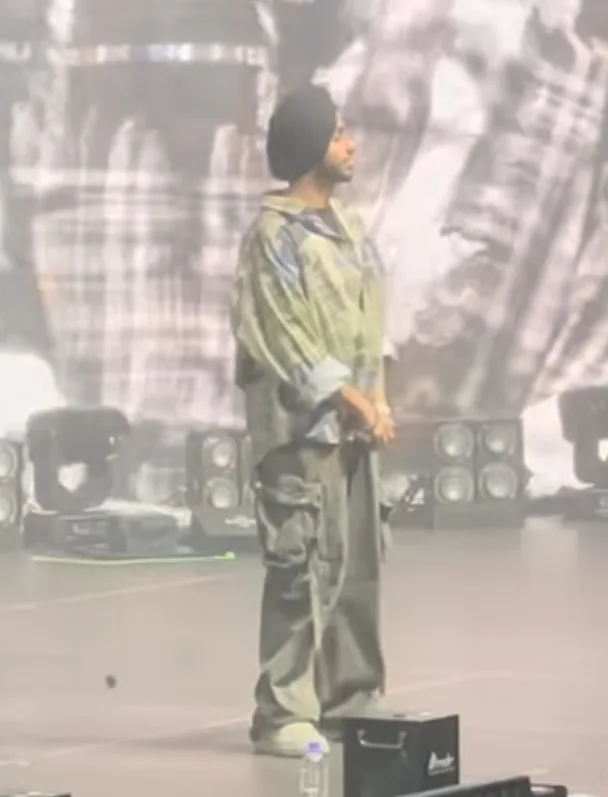
Quick highlights:
- Born Shubhneet Singh on 10 August 1997 in Nangal; based in Brampton, Canada
- Debut single "We Rollin" arrived in 2021; his first album, Still Rollin, followed in 2023
- Releases his music independently and keeps an unusually low public profile
- Followed with the EP Leo (2024), the album Sicario (January 2025) and the single "Supreme" (2025)
Shubh is the quietest career on this list and one of the fastest. A melodic, half-sung style over trap production carried "We Rollin", "Elevated" and "Baller" from YouTube uploads to the Billboard charts in under two years, with almost no interviews and no label machine behind them — the songs, nearly all written by Shubh himself, did the work.
The albums have kept the pace: Still Rollin (2023) charted on the Canadian Albums Chart, Sicario followed in January 2025, and "Cheques" reached number three on the Billboard India Songs chart. For the streaming generation, Shubh is the proof that the route from a Brampton bedroom to global charts is now a normal career path.
| Born | 10 August 1997, Nangal; based in Brampton, Canada |
| Known for | Melodic Punjabi hip-hop released independently |
| Signature songs | "We Rollin", "Baller", "Cheques", "No Love", "Supreme" |
How These Singers Changed Punjabi Music
Read in sequence, the fifteen careers describe five shifts that made modern Punjabi music. Each shift was driven by a new way of reaching listeners, and each left the language itself more central, not less.
- Preservation came first. Surinder Kaur and Kuldeep Manak recorded the folk repertoire — wedding songs, laments and epic ballads — before the oral tradition that carried it could fade.
- The cassette changed the economics. Chamkila proved that live performance and cheap tapes could make a folk singer the biggest commercial act in Punjab without radio's permission.
- Bhangra went pop. Daler Mehndi and Sukhbir packaged Punjabi rhythm for satellite television and the diaspora wedding circuit, making Punjabi the party language of Indians worldwide.
- The diaspora took over production. In the streaming era the industry's centre of gravity moved to Brampton, Surrey and Vancouver, where Moose Wala, AP Dhillon, Karan Aujla and Shubh built audiences larger than Punjab itself could offer.
- The mainstream breakthrough followed. Diljit at Coachella and the Met Gala, Aujla's "Tauba Tauba" in a Bollywood hit and Hans Raj Hans singing with Nusrat Fateh Ali Khan mark the points where Punjabi music stopped being filed as a regional category.
Through every shift the constant is language pride. Each generation found a new technology — radio, cassette, satellite television, streaming — and used it to keep Punjabi at the centre of the song.
Frequently Asked Questions About Famous Punjabi Singers
Who is the most famous Punjabi singer?
It depends on the era. Gurdas Maan is the most decorated living legend; Diljit Dosanjh is the biggest global live draw, as the first Punjabi-language singer to perform at Coachella; and Sidhu Moose Wala's catalogue makes him one of the most-streamed Punjabi artists ever. For earlier generations, Surinder Kaur and Amar Singh Chamkila defined what fame in Punjabi music meant.
Who is called the Nightingale of Punjab?
Surinder Kaur (1929–2006), also known in Punjabi as Punjab di Koyal. She pioneered and popularised Punjabi folk singing from her first Lahore Radio broadcasts in 1943, and received the Padma Shri in 2006.
Who was known as the Elvis of Punjab?
Amar Singh Chamkila (1960–1988), whose duets with Amarjot made him the highest-selling Punjabi singer of the cassette era. He and Amarjot were killed in 1988; the case remains unsolved, and his story reached a new audience through the 2024 film Amar Singh Chamkila.
What is a kali in Punjabi music?
A kali is a long-form narrative folk ballad, sung to tell a complete story such as Heer-Ranjha or Mirza-Sahiban. Kuldeep Manak, the Kaliyan da Badshah or King of Kaliyan, was its most celebrated singer, and his "Tere Tille Ton" is the form's best-known recording.
Which Punjabi singers have performed at Coachella and the Juno Awards?
Diljit Dosanjh performed at Coachella in April 2023, the first Punjabi-language singer to appear at the festival. AP Dhillon was the first Punjabi-language artist to perform at Canada's Juno Awards, in 2023, and Karan Aujla won the TikTok JUNO Fan Choice Award in 2024.
Who is the Prince of Bhangra?
Sukhbir, the Dubai-based singer whose 1990s albums fused bhangra with rap, reggae and techno. His "Ishq Tera Tadpave (Oh Ho Ho Ho)" remains one of the most played Punjabi party songs ever recorded.
Conclusion — A Century of Punjabi Voices
From a teenager singing into a Lahore radio microphone in 1943 to a Brampton singer topping charts from home recordings, Punjabi music has reinvented its delivery in every generation while refusing to change the language it sings in. These fifteen singers are not the whole story, but they are its essential chapters.
Sources and Photograph Credits
Research note: dates, songs, awards and chart facts in this article were checked in November 2026 against the singers' reference biographies, official and label reporting, and reputable music press, including Billboard and Official Charts reporting and award records. Where sources disagree on a detail — as they do on the year of Gurdas Maan's Padma Shri — the article states the honour without the disputed year rather than repeat an unverified date.
Photographs are from Wikimedia Commons under the licences credited below. Amar Singh Chamkila and Kuldeep Manak are profiled without photographs because no verifiably correct freely licensed image of either could be confirmed.
Photo credits:
- Surinder Kaur — President's Secretariat, Government Open Data License – India.
- Gurdas Maan — Ministry of Information and Broadcasting, GODL-India.
- Hans Raj Hans — President's Secretariat, GODL-India.
- Daler Mehndi — Phronesisindia, CC BY-SA 4.0.
- Sukhbir — Bollywood Hungama, CC BY 3.0.
- Babbu Maan — LFC24, CC BY-SA 3.0.
- Diljit Dosanjh — Laura Lee Dooley, CC BY 2.0.
- Sidhu Moose Wala — Shekha Gill, CC BY-SA 4.0.
- Ammy Virk — ABP Sanjha, CC BY 3.0.
- Jasmine Sandlas — Jokepie, CC BY-SA 4.0.
- AP Dhillon — Deeozzz, CC BY-SA 4.0.
- Karan Aujla — Geetandimachine, CC BY-SA 4.0.
- Shubh — Travel world with me, CC BY 3.0 (cropped to centre the performer).
Full file-page links are listed in the sources document supplied with this article.
Keep exploring

Top 50 Most Popular Native American Actresses
For generations, Native American actresses have enriched our screens with powerful performances, despite an industry that has often offered limited…

Best Fashion Designers: 15 Designers to Know — Global Icons and Indian Greats
From Coco Chanel, Christian Dior and Yves Saint Laurent to Ritu Kumar, Sabyasachi Mukherjee and Masaba Gupta — 15 fashion designers to know, each…
Most Influential Women in the World: 15 Women Who Changed History
From Marie Curie, the only person to win Nobel Prizes in two different sciences, to Malala Yousafzai, the youngest Nobel laureate in history — 15…